
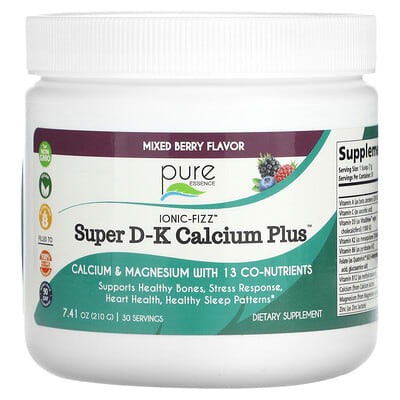
Super D-K Calcium Plus Mixed Berry Flavor

Goals
$29.37 $0.97 per serving

Product analysis
Super D-K Calcium Plus Mixed Berry Flavor can help fill mineral gaps and support normal bone maintenance. Its unidentified blend contents make the full formula harder to judge.
AI assessment of the formula, label and price. How scoring works
Nutrient Quality44
MK-7, the folate preparation and potassium bicarbonate are favorable features of the nutrient mix. The calcium and magnesium preparations are less favorable for absorption, while several other quality details remain uncertain.
Ingredient Transparency72
Ingredient amounts and most forms are disclosed. The unidentified blend contents and several unspecified forms still limit a complete comparison.
Value For Money38
Potassium contributes favorable value, but calcium, magnesium and vitamin K offer weak value for the serving cost. Value for many of the other nutrients remains uncertain.
Customer Satisfaction71
Customer feedback is very positive, but only a small number of ratings supports it. That leaves more uncertainty about typical satisfaction.
Product Focus21
Calcium, magnesium and vitamin D provide partial support for bone and mineral nutrition. The smaller MK-7 and potassium amounts do not match the exposures behind some of the longer-term findings, and the unidentified blend limits a complete judgment.
- Format
Powder - Container
- 7 Ounce(s)
- Per serving
- $0.97
- Customer rating
- 4.7 · 57 ratings
Goals

Impact
High effect
Vitamin K · 45 mcgMagnesium · 300 mgCalcium · 250 mgVitamin D · 25 mcgCopper · 0.25 mgManganese · 1 mgBoron · 500 mcgZinc · 2 mgVitamin C · 250 mg

Impact
High effect
Vitamin K · 45 mcgMagnesium · 300 mgVitamin B12 · 30 mcgVitamin B6 · 1 mgFolate · 50 mcgVitamin D · 25 mcg

Impact
High effect
Folate · 50 mcgVitamin B12 · 30 mcgVitamin D · 25 mcgMagnesium · 300 mgVitamin K · 45 mcgBoron · 500 mcgZinc · 2 mgVitamin C · 250 mg

Impact
Moderate effect
Vitamin D · 25 mcgMagnesium · 300 mgVitamin B12 · 30 mcgPotassium · 100 mg

Impact
High effect
Vitamin K · 45 mcgPotassium · 100 mgMagnesium · 300 mgVitamin D · 25 mcgVitamin B12 · 30 mcgVitamin B6 · 1 mgFolate · 50 mcgVitamin C · 250 mg

Impact
Moderate effect
Vitamin D · 25 mcgMagnesium · 300 mgFolate · 50 mcgVitamin B12 · 30 mcgVitamin B6 · 1 mgVitamin C · 250 mg

Impact
High effect
Magnesium · 300 mgZinc · 2 mgVitamin D · 25 mcgBoron · 500 mcg
Vitamin B6 Not classified
No linked studies yet.
Ingredients
| Ingredient | Amount per serving | Score |
|---|---|---|
Vitamin A (Beta-Carotene) | 150 mcg | |
Vitamin C (Ascorbic Acid) | 250 mg | |
Vitamin D3 | 25 mcg | |
Vitamin K2 (Menaquinone-7) | 45 mcg | |
Vitamin B6 (Pyridoxine Hydrochloride) | 1 mg | |
Folate (L-5-Methyltetrahydrofolate) | 50 mcg | |
Vitamin B12 (Methylcobalamin) | 30 mcg | |
Calcium (Calcium Lactate) | 250 mg | |
Magnesium (Magnesium Carbonate) | 300 mg | |
Zinc (Zinc Lactate) | 2 mg | |
Copper (Copper Gluconate) | 0.25 mg | |
Manganese (Manganese Gluconate) | 1 mg | |
Potassium (Potassium Bicarbonate) | 100 mg | |
Bamboo extract | 60 mg | |
Beet powder | 10 mg | |
ionic Sea Minerals | 10 mg | |
Grape extract | 8 mg | |
Boron (Boron Citrate) | 500 mcg |
Folate (L-5-Methyltetrahydrofolate) · 50 mcg OverallScore45
Vitamin K (Menaquinone-7) · 45 mcg OverallScore71
Potassium (Potassium Bicarbonate) · 100 mg OverallScore62
Alternative products
Report alternatives
Sources
Published studies used for the product analysis and the top-ranked studies for each ingredient and goal.
- [Comparative study of the urinary excretion of boron, calcium, magnesium and phosphorus in postmenopausal women with and without osteoporosis].
- Effect of dietary boron on mineral, estrogen, and testosterone metabolism in postmenopausal women.
- The relationship between boron and magnesium status and bone mineral density in the human: a review.
- Effects of boron supplementation on bone mineral density and dietary, blood, and urinary calcium, phosphorus, magnesium, and boron in female athletes.
- Metabolic responses of postmenopausal women to supplemental dietary boron and aluminum during usual and low magnesium intake: boron, calcium, and magnesium absorption and retention and blood mineral concentrations
- What is the impact of daily oral supplementation of vitamin D3 (cholecalciferol) plus calcium on the incidence of hip fracture in older people? A systematic review and meta-analysis.
- Calcium supplementation prevents seasonal bone loss and changes in biochemical markers of bone turnover in elderly New England women: a randomized placebo-controlled trial.
- The effects of calcium supplementation (milk powder or tablets) and exercise on bone density in postmenopausal women.
- The efficacy of calcium supplementation alone in elderly Thai women over a 2-year period: a randomized controlled trial.
- Calcium-enriched foods and bone mass growth in prepubertal girls: a randomized, double-blind, placebo-controlled trial.
- The Association between Dietary and Circulating Copper Levels and Osteoporosis: a Scoping Review.
- Association between dietary copper, iron, zinc, selenium intake and osteopenia or osteoporosis in elderly hypertensive patients: a retrospective cohort study.
- Associations of dietary copper intake with total bone mineral density and lumbar spine bone mineral density in American adults.
- The association between dietary mineral intake and bone mineral density: a cross-sectional study.
- Association between dietary copper intake and bone mineral density in children and adolescents aged 8-19 years: A cross-sectional study.
- Association between RBC folate and lumbar bone mineral density in postmenopausal women, a cross-sectional study from NHANES 2009-2018.
- Genetic variants modify the associations of concentrations of methylmalonic acid, vitamin B-12, vitamin B-6, and folate with bone mineral density.
- Adequate Intake and Supplementation of B Vitamins, in Particular Folic Acid, can Play a Protective Role in Bone Health.
- Relation of homocysteine, folate, and vitamin B12 to bone mineral density of postmenopausal women.
- Dietary intake of folate, but not vitamin B2 or B12, is associated with increased bone mineral density 5 years after the menopause: results from a 10-year follow-up study in early postmenopausal women.