
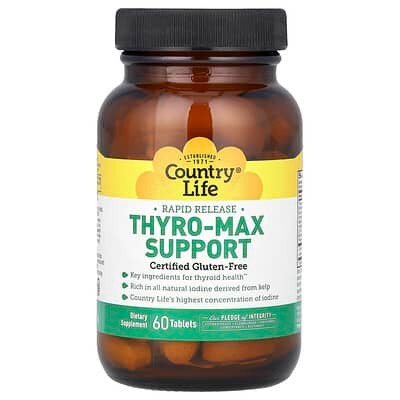

$19.99 $0.66 per serving


Product analysis
Thyro-Max Support supplies nutrients that support normal energy use and thyroid function when intake is low. The mixed magnesium forms have undisclosed proportions, making their quality harder to compare.
AI assessment of the formula, label and price. How scoring works
Nutrient Quality55
The nutrient forms vary in quality, with favorable potassium and manganese forms alongside a less favorable magnesium mix. Unclear blend proportions limit how precisely the magnesium can be judged.
Ingredient Transparency74
All ingredient amounts and most forms are stated, which helps you compare the formula. The shares of the niacin and magnesium forms are missing, so their exact makeup remains unclear.
Value For Money43
Value varies across the formula, with potassium looking economical and tyrosine relatively costly for the amount. The magnesium mix also offers limited value, so the broad combination is not uniformly economical.
Customer Satisfaction80
Customer ratings show consistently positive feedback from many buyers. The feedback does not establish improved thyroid function or energy.
Product Focus60
The clearest role is helping meet nutrient needs involved in normal energy use and thyroid function. Benefits depend mainly on dietary shortfalls, with less certainty about routine energy or stress improvement.
- Format
Tablet - Container
- 60 Tablet(s)
- Per serving
- $0.66
- Customer rating
- 4.7 · 882 ratings
Goals

Impact
High effect
Niacin · 50 mgRiboflavin · 50 mgThiamin · 30 mgZinc · 10 mgMagnesium · 200 mg
B vitamins help the body use energy from food, with thiamin supporting carbohydrate metabolism and other B vitamins serving as enzyme helpers. These normal functions do not show that extra vitamins raise energy expenditure when intake is adequate. Iodine supports thyroid hormone production; filling an iodine shortfall can restore this function, but extra iodine does not stimulate an already normal thyroid.
How this product is rated for Metabolism Support
Ingredient fit70
The formula supplies nutrients involved in normal metabolism, with varied amounts and a broader focus than direct energy expenditure.
Goal fit
Recognized metabolic nutrients contribute to the saved finding, while other actives and the product’s broader uses reduce its focus on this goal.
Dose adequacy
Declared amounts provide partial coverage of the supplied comparisons, which do not establish doses that increase calorie expenditure.
Pathways0
The counted ingredients do not contribute to the evaluated direct energy-expenditure pathways.
Depth
No direct energy-expenditure pathway receives a contribution from the counted ingredients.
Breadth
No evaluated pathway reaches the supplied coverage threshold.
Evidence100
Evidence for normal nutrient functions supports the saved finding; it does not establish an extra metabolic boost when intake is adequate.
Evidence strength
Thiamin supplies the strongest saved evidence finding; normal carbohydrate metabolism does not demonstrate a further metabolic boost with adequate intake.
Studied preparation
The counted preparations match those recognized in the supplied comparison; this does not establish thermogenic benefit for the finished product.
Formulation logic100
No unmet partner requirement or specified conflict was identified. The counted ingredients meet the supplied minimum amount comparisons.
Partner coverage
The counted ingredients have no unmet partner requirement in the supplied findings; this does not establish additional benefit from combining them.
Conflicts
No specified ingredient conflict was identified in the supplied findings.
Effective doses
All counted ingredients meet the supplied minimum amount comparison, which is not a demonstrated threshold for increased calorie expenditure.

Impact
High effect
Iodine · 450 mcgMagnesium · 200 mgRiboflavin · 50 mgThiamin · 30 mgPotassium · 198 mg
Magnesium, riboflavin and niacin can help address tiredness caused by their respective deficiencies. Iodine's role in thyroid physiology and potassium's electrolyte role do not establish routine energy improvement. Tyrosine received a saved contribution, but stress-task findings do not demonstrate everyday vitality. These ingredients do not establish an energy boost when nutrient intake is adequate.
How this product is rated for Energy
Ingredient fit75
Magnesium provides a relevant contribution, primarily for deficiency-related tiredness. The formula's amounts contribute at differing levels.
Goal fit
Magnesium provides a relevant contribution, primarily for deficiency-related tiredness.
Dose adequacy
The retained amounts reach the saved comparison range; higher amounts do not establish greater energy or fatigue relief.
Pathways5
Only a small stress-fatigue contribution is retained from tyrosine; no area reaches the coverage requirement.
Depth
A small stress-fatigue contribution is retained, without established routine vitality.
Breadth
No configured energy area reaches the saved coverage threshold.
Evidence86
Magnesium supplies the leading saved evidence contribution. Its relevant population and use conditions limit expectations.
Evidence strength
Magnesium supplies the leading evidence contribution, with its specific nutritional, population or exercise limitations.
Studied preparation
Iodine and tyrosine do not meet the preparation check; the other retained contributors meet it.
Formulation logic100
The retained contributors need no missing partner under the supplied checks. No configured conflict was found.
Partner coverage
The retained contributors can contribute without an additional partner under the supplied checks; no extra combination benefit is established.
Conflicts
No configured conflict was found; the supplied checks do not evaluate every possible interaction.
Effective doses
Every retained contributor reaches the saved minimum amount condition; this does not establish an effective fatigue-treatment or exercise regimen.
L-Tyrosine Not classified
No linked studies yet.

Impact
High effect
Magnesium · 200 mgZinc · 10 mg
Magnesium provides a nutritional contribution when dietary intake is low. The declared B vitamins contribute to ordinary nutrient availability, with their main connection here in metabolism. These nutritional roles do not establish additional health benefits when intake is already adequate.
How this product is rated for Everyday Health
Ingredient fit74
The declared nutrients provide a nutritional connection to general health. Amount support varies across contributing ingredients.
Goal fit
The declared nutrients provide general nutritional connections alongside the formula’s other ingredients.
Dose adequacy
Contributing amounts provide partial support against the saved amount references; the reference comparison does not establish a clinical dose-response.
Pathways60
The strongest connection is energy metabolism cofactors. The formula also represents the areas listed below.
Depth
The strongest represented area is energy metabolism cofactors, describing nutritional roles rather than a measured improvement in health.
Breadth
The represented areas are energy metabolism cofactors.
Evidence86
Magnesium is the leading retained contribution. The supplied context supports nutritional availability when intake is low, without establishing added benefit with adequate intake.
Evidence strength
Magnesium provides the leading retained contribution; its nutritional relevance does not establish broad disease prevention.
Studied preparation
The retained preparations meet the saved checks; no superiority of chemical form or delivery follows.
Formulation logic100
No configured conflict or missing required partner was identified; the retained amount threshold does not establish clinical effectiveness.
Partner coverage
No required partner is missing among the retained ingredients; combining them does not establish extra health benefit.
Conflicts
No configured ingredient conflict was identified.
Effective doses
The retained ingredients meet the amount threshold used here, which is not proof of clinical benefit.

Impact
High effect
Magnesium · 200 mg
Magnesium and potassium support electrolyte balance and may modestly influence blood pressure, with potassium effects depending on initial intake and blood pressure. The declared amounts offer a limited comparison with studied exposures rather than a proven blood-pressure regimen. Thiamin helps protect normal heart function when intake is deficient; amounts beyond nutritional needs do not establish added cardiovascular benefit.
How this product is rated for Heart Health
Ingredient fit58
The relevant nutrients provide the main recognized connection. The relevant nutrients provide partial exposure coverage in the saved comparison, without establishing a proven effective dose.
Goal fit
The relevant nutrients are the main recognized focus. Other actives broaden the formula beyond these heart-related roles.
Dose adequacy
The relevant nutrients provide partial exposure coverage in the saved comparison, without establishing a proven effective dose.
Pathways48
The findings center on electrolyte balance and vascular tone, with narrow coverage across the evaluated functions.
Depth
The main recognized connection is electrolyte balance and vascular tone.
Breadth
The breadth finding centers on electrolyte balance and vascular tone, rather than broad coverage of different heart-health functions.
Evidence89
The strongest recognized nutrient evidence remains limited or conditional rather than proof of broad cardiovascular protection.
Evidence strength
The strongest recognized nutrient evidence remains limited or conditional rather than proof of broad cardiovascular protection.
Studied preparation
The saved preparation check recognizes the counted declarations; this does not establish product-specific trial results.
Formulation logic100
The relevant nutrients have no identified required-partner gap or configured conflict. All ingredients counted for this check meet its minimum exposure criterion; that criterion is not proof of clinical benefit.
Partner coverage
No missing required partner was identified among the counted ingredients; this does not establish added benefit from combining them.
Conflicts
No configured ingredient conflict was identified in the supplied facts.
Effective doses
All ingredients counted for this check meet its minimum exposure criterion; that criterion is not proof of clinical benefit.

Impact
High effect
Potassium · 198 mgMagnesium · 200 mgNiacin · 50 mg
Potassium may modestly support blood pressure when habitual intake is low, while magnesium findings for blood pressure and arterial stiffness are inconsistent. This potassium serving is well below the exposures in the supplied trials despite receiving full amount recognition. Thiamin supports heart function in deficiency, with no added cardiovascular benefit established at adequate intake. The mixed niacin forms do not establish the effects of pharmacological nicotinic acid.
How this product is rated for Cardiovascular Support
Ingredient fit61
Potassium is the main recognized ingredient; smaller or unresolved amounts reduce the serving’s contribution.
Goal fit
Ingredients aimed at other goals dilute the formula’s cardiovascular focus.
Dose adequacy
Smaller or unresolved ingredient quantities limit the serving’s amount contribution; partial recognition does not establish a measured dose-response.
Pathways60
The strongest assigned contribution concerns vascular tone and sodium balance. Other cardiovascular mechanisms have less or no assigned coverage.
Depth
The strongest assigned support concerns vascular tone and sodium balance, rather than comprehensive cardiovascular protection.
Breadth
Only vascular tone and sodium balance reaches the coverage threshold.
Evidence86
Potassium leads the evidence findings. The supplied population and preparation limits remain relevant to expectations.
Evidence strength
Potassium provides the leading evidence contribution; its marker findings do not establish prevention of cardiovascular events.
Studied preparation
The counted preparations are recognized as studied, with the population and exposure distinctions described for the relevant ingredients.
Formulation logic100
The counted ingredients have no unmet partner requirement or identified configured conflict; amount thresholds are considered separately.
Partner coverage
No unmet partner requirement is identified for the counted ingredients; combining them does not establish an added benefit.
Conflicts
No configured ingredient conflict was identified.
Effective doses
All counted ingredients clear the minimum amount threshold, which is distinct from a proven effective dose.

Impact
Moderate effect
Thiamin · 30 mgMagnesium · 200 mg
Thiamin and niacin help meet nutritional needs relevant to normal brain function, and magnesium supports normal nerve activity. Tyrosine supplies material for brain messengers, though its limited performance findings concern acute stress or sleep loss.
How this product is rated for Brain Health
Ingredient fit61
The saved findings identify 5 relevant ingredients alongside 5 other actives.
Goal fit
5 ingredients contribute to the saved goal-fit finding, while 5 other actives broaden its focus.
Dose adequacy
The saved amount assessment considers 5 ingredients against their individual references.
Pathways17
The main saved connection concerns stress and arousal regulation.
Depth
Stress and arousal regulation is the strongest saved area, remaining below the coverage threshold.
Breadth
No assessed area reaches the saved coverage threshold.
Evidence86
Magnesium supplies the strongest saved evidence finding, which must be read within the limits of the supplied research.
Evidence strength
Magnesium leads the evidence finding among ingredients meeting the saved minimum amount reference.
Studied preparation
The saved assessment marks the preparations of 5 counted ingredients as meeting its evidence requirements.
Formulation logic100
The saved checks record no missing required partner or matched ingredient conflict.
Partner coverage
Each counted ingredient can contribute independently under the saved assessment or has its required partner.
Conflicts
No configured ingredient conflict is recorded.
Effective doses
All 5 counted ingredients meet the saved minimum amount threshold.
Ingredients
| Ingredient | Amount per serving | Score |
|---|---|---|
Thiamine (Thiamine Hydrochloride) | 30 mg | |
Riboflavin | 50 mg | |
Niacin (Niacinamide) | 50 mg | |
Iodine (Kelp) | 450 mcg | |
Magnesium (Magnesium Aspartate, Magnesium Oxide) | 200 mg | |
Zinc (Zinc Picolinate) | 10 mg | |
Manganese (Manganese Citrate) | 10 mg | |
Potassium (Potassium Aspartate) | 198 mg | |
L-Tyrosine | 500 mg | |
L-Aspartic Acid | 200 mg |
Manganese (Manganese Citrate) · 10 mg OverallScore82
Each serving provides 10 mg of manganese. The amount is close to the adult upper limit used in the evaluation, making the serving amount important when comparing products.
How this ingredient is rated
Active Ingredient Quality & Bioavailability80
The identified manganese form is manganese citrate.
Manganese Chemical Form
The saved facts identify manganese citrate as the manganese form.
Dose, Safety & Label Transparency100
Each serving discloses 10 mg of manganese, close to the adult upper limit used in the evaluation.
Manganese Dosage Efficacy & Safety
The 10 mg per serving is close to the adult upper limit considered in the evaluation.
Elemental Weight Disclosure
The label amount is recorded as 10 mg of manganese per serving.
Value50
A whole-product serving costs about $0.67, covering any other ingredients too.
Price per Serving vs. Median
The evaluated price is about $0.67 per whole-product serving.
Potassium (Potassium Aspartate) · 198 mg OverallScore85
A serving provides 198 mg of potassium as potassium aspartate, a moderate amount. A whole-product serving costs about $0.67.
How this ingredient is rated
Active Ingredient Quality & Bioavailability100
The identified form is potassium aspartate.
Potassium Form Quality
The identified form is potassium aspartate.
Dose, Safety & Label Transparency64
A serving provides 198 mg of potassium, a moderate amount. The potassium amount is known, but explicit elemental-potassium wording was not established in the available evidence.
Potassium Dosage Potency
A serving provides 198 mg of potassium, a moderate amount.
Elemental Yield Transparency
The potassium amount is known, but explicit elemental-potassium wording was not established in the available evidence.
Value100
A whole-product serving costs about $0.67.
Potassium Value Efficiency
A whole-product serving costs about $0.67.
Iodine (Kelp) · 450 mcg OverallScore58
Each serving provides 450 mcg of iodine, more than needed for basic daily support. Its recorded marine source does not establish the chemical form.
How this ingredient is rated
Active Ingredient Quality & Bioavailability34
The chemical form is unknown in the saved facts, and the recorded marine source has no qualifying sourcing marker.
Iodine Form & Bioavailability
The recorded chemical form is unknown; a marine source does not identify it.
Marine Source Purity & Sourcing
A marine source is recorded, but the saved facts do not record an organic or qualifying geographic sourcing claim.
Dose, Safety & Label Transparency85
The declared 450 mcg of iodine per serving is above the amount needed for basic daily support but below the upper intake limit.
Dosage Efficacy for Daily Support
450 mcg per serving is more than needed for basic daily support.
Dosage Safety & Upper Limits
The 450 mcg serving is below the upper intake limit used in the evaluation.
Elemental Iodine Transparency
The iodine amount is declared as 450 mcg per serving.
Value50
A whole-product serving costs about $0.67.
Price Per Effective Serving
The whole-product serving costs about $0.67.
Alternative products
Report alternatives
Sources
Published studies used for the product analysis and the top-ranked studies for each ingredient and goal.
- Association between Serum Magnesium and Fractures: A Systematic Review and Meta-Analysis of Observational Studies.
- Bioabsorbable Magnesium-Based Materials Potential and Safety in Bone Surgery: A Systematic Review.
- Vascularized bone grafting fixed by biodegradable magnesium screw for treating osteonecrosis of the femoral head.
- An update on magnesium and bone health.
- Sex-specific differences in the association of magnesium intake with femoral neck bone mineral density among older adults.
- Risk of Environmental Chemicals on Bone Fractures Is Independent of Low Bone Mass in US Adults: Insights from 2017 to 2018 NHANES.
- The Manganese-Bone Connection: Investigating the Role of Manganese in Bone Health.
- Associations of multiple metals with bone mineral density: A population-based study in US adults.
- Sex-specific associations of urinary mixed-metal concentrations with femoral bone mineral density among older people: an NHANES (2017-2020) analysis.
- Relationship between blood manganese and bone mineral density and bone mineral content in adults: A population-based cross-sectional study.
- Effect of potassium citrate on bone density, microarchitecture, and fracture risk in healthy older adults without osteoporosis: a randomized controlled trial.
- Long-term persistence of the urine calcium-lowering effect of potassium bicarbonate in postmenopausal women.
- Partial neutralization of the acidogenic Western diet with potassium citrate increases bone mass in postmenopausal women with osteopenia.
- Potassium citrate supplementation results in sustained improvement in calcium balance in older men and women.
- Effects of potassium chloride and potassium bicarbonate on endothelial function, cardiovascular risk factors, and bone turnover in mild hypertensives.
- Increased incidence of fractures in middle-aged and elderly men with low intakes of phosphorus and zinc.
- Zinc Supplementation Increases Procollagen Type 1 Amino-Terminal Propeptide in Premenarcheal Girls: A Randomized Controlled Trial.
- Randomized controlled trial of prenatal zinc supplementation and fetal bone growth.
- The effects of zinc supplementation on serum zinc, alkaline phosphatase activity and fracture healing of bones.
- Is Zinc an Important Trace Element on Bone-Related Diseases and Complications? A Meta-analysis and Systematic Review from Serum Level, Dietary Intake, and Supplementation Aspects.