
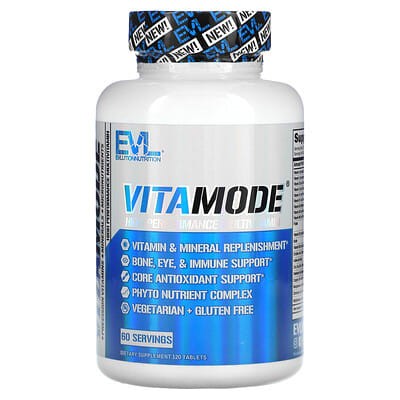

$18.99 $0.31 per serving


Product analysis
VitaMode brings a wide range of vitamins, minerals and additional ingredients into one formula. Its undisclosed blend components and some unspecified nutrient forms make it harder to judge the extras alongside the core nutrients.
AI assessment of the formula, label and price. How scoring works
Nutrient Quality46
Ingredient quality varies across the formula, with favorable forms for B5, manganese and chromium. Some other forms and both blends remain unclear, limiting a consistent quality judgment across the whole formula.
Ingredient Transparency70
All listed amounts and most ingredient forms are disclosed, helping with nutrient comparisons. Both blends omit their individual components, leaving their contents harder to assess.
Value For Money52
Value depends on which nutrients matter to you, with favorable cost comparisons for several vitamins and minerals. Choline, B5 and some added ingredients offer less value, so breadth alone does not establish a good buy.
Customer Satisfaction89
Customer feedback is very favorable across a large review pool. That gives a broad view of satisfaction without proving the formula’s benefits.
Product Focus6
The formula covers many goals rather than concentrating on a single purpose. Its broad ingredient mix may suit buyers seeking variety, but the intended benefits remain uncertain.
- Format
Tablet - Container
- 120 Tablet(s)
- Per serving
- $0.31
- Customer rating
- 4.8 · 3,091 ratings
Goals

Impact
Highest effect
Vitamin C · 500 mgZinc · 15 mgVitamin A · 1800 mcgVitamin D · 125 mcgSelenium · 200 mcg
Vitamins A and D support normal immune function, with vitamin A also helping maintain protective barriers. Zinc and selenium contribute to immune-cell function and antioxidant defenses, while B6, B12 and folate help restore immune function when intake is low. These nutrient roles do not establish extra protection from infections when intake is adequate. Vitamin C adds limited regular-use cold-duration support. The larger vitamin D amount does not establish greater infection protection.
How this product is rated for Immunity
Ingredient fit60
The formula includes nutrients relevant to normal immune function, alongside ingredients serving other purposes. Their amounts make uneven contributions.
Goal fit
Several nutrients support normal immune functions, although the wider formula also serves other nutritional purposes.
Dose adequacy
The known amounts contribute unevenly: some meet the saved comparisons while smaller nutrient amounts limit the overall amount finding.
Pathways100
The saved findings span barriers, innate immune cells, immune regulation and oxidative balance.
Depth
The strongest saved contribution concerns protective barriers and antimicrobial defense.
Breadth
The saved findings span barriers, innate immune cells, immune regulation and oxidative balance.
Evidence100
Vitamin C leads the saved evidence finding, with modest regular-use cold-duration support rather than established infection prevention.
Evidence strength
Vitamin C leads the saved evidence finding, with modest regular-use cold-duration support rather than established infection prevention.
Studied preparation
The saved preparation finding accepts the relevant nutrient declarations; this does not imply that the complete formula was clinically tested.
Formulation logic100
The relevant nutrients do not require an additional partner in the saved findings, and no matching high-zinc conflict was identified.
Partner coverage
The relevant nutrients can contribute without an additional partner under the saved findings.
Conflicts
The saved checks did not identify a matching high-zinc conflict; this is not a complete assessment of all possible interactions.
Effective doses
All ingredients included in this saved check pass its minimum amount threshold; that finding does not establish effectiveness of every formula ingredient.

Impact
Highest effect
Folate · 680 mcg DFEVitamin B12 · 100 mcgVitamin D · 125 mcgVitamin K · 80 mcgBoron · 2 mgSelenium · 200 mcgZinc · 15 mgVitamin C · 500 mg
B vitamins contribute to normal energy metabolism, while folate and vitamin B12 support blood formation. Vitamin D supports bone and mineral functions, and zinc and selenium contribute to normal immune and antioxidant functions. These nutrients can help fill dietary gaps; amounts above nutritional needs do not establish additional health benefits.
How this product is rated for Everyday Health
Ingredient fit73
The formula's supported contribution comes from its relevant declared ingredients. Their amounts and the presence of other actives determine how concentrated that contribution is.
Goal fit
The relevant ingredients share the formula with ingredients whose broader general health contribution is not established here.
Dose adequacy
Most relevant amounts make substantial contributions, although some remain below their supplied comparison endpoints.
Pathways100
The strongest represented area is energy metabolism cofactors, with substantial coverage from the relevant ingredients. 4 areas reach substantial coverage, covering several aspects of the goal.
Depth
The strongest represented area is energy metabolism cofactors, with substantial coverage from the relevant ingredients.
Breadth
4 areas reach substantial coverage, covering several aspects of the goal.
Evidence82
The supplied findings support specific nutrient roles or narrower ingredient uses. Preparation matching does not by itself establish broad health benefit.
Evidence strength
Vitamin B9 (Folate) provides the strongest supported contribution in the saved findings; nutrient availability or narrower findings do not prove broad health improvement.
Studied preparation
The relevant ingredients meet the supplied preparation criteria, without establishing superiority of every listed form.
Formulation logic100
The relevant ingredients have no unmet partner requirement and trigger none of the evaluated conflicts. Their declared amounts meet the supplied minimum comparison level.
Partner coverage
The relevant ingredients can contribute independently or have their required partner present; this does not establish added combination benefit.
Conflicts
None of the evaluated ingredient conflicts was triggered; this is not a comprehensive safety assessment.
Effective doses
The relevant amounts meet the supplied minimum comparison level, which is not a proven clinical response threshold.

Impact
Moderate effect
Iodine · 150 mcgVitamin D · 125 mcgVitamin B5 · 75 mgRiboflavin · 10 mgThiamin · 10 mgVitamin B12 · 100 mcg
Riboflavin, B6, B12, folate, niacin, pantothenic acid and vitamin C support nutritional needs that can matter for tiredness. Their larger amounts offer no established additional energy benefit in people with adequate intake. Caffeine-bearing botanicals do not provide a reliable alertness contribution without a declared caffeine amount.
How this product is rated for Energy
Ingredient fit64
9 ingredients contribute to the saved energy assessment, alongside a broader set of active ingredients that makes the focus less specific. The contributing amounts align reasonably well with the saved dose benchmarks, with some shortfalls.
Goal fit
9 ingredients contribute to the saved energy assessment, alongside a broader set of active ingredients that makes the focus less specific.
Dose adequacy
The contributing amounts align reasonably well with the saved dose benchmarks, with some shortfalls.
Pathways0
No reviewed functional area has a recorded contribution. No functional area reaches the saved coverage threshold.
Depth
No reviewed functional area has a recorded contribution.
Breadth
No functional area reaches the saved coverage threshold.
Evidence94
Vitamin D provides the strongest qualifying evidence in the saved assessment; the relevant benefit remains limited to its reviewed outcome. The saved preparation review is limited by Iodine, which was not matched to the studied preparation.
Evidence strength
Vitamin D provides the strongest qualifying evidence in the saved assessment; the relevant benefit remains limited to its reviewed outcome.
Studied preparation
The saved preparation review is limited by Iodine, which was not matched to the studied preparation.
Formulation logic100
The contributing ingredients can work alone or have their required partner present. No ingredient conflicts were recorded in the saved assessment. All contributing ingredients reach the saved meaningful-dose threshold.
Partner coverage
The contributing ingredients can work alone or have their required partner present.
Conflicts
No ingredient conflicts were recorded in the saved assessment.
Effective doses
All contributing ingredients reach the saved meaningful-dose threshold.
Vitamin B5 Not classified
No linked studies yet.

Impact
High effect
Folate · 680 mcg DFEVitamin B12 · 100 mcgVitamin B6 · 50 mgMolybdenum · 80 mcgSelenium · 200 mcgVitamin E · 13.5 mgZinc · 15 mgVitamin C · 500 mgCholine · 10 mgRiboflavin · 10 mg
Choline has a nutritional liver-function role, but the small amount in this serving contributes little to the saved comparison. Folate has limited relevance to arsenic elimination when folate intake is low and arsenic exposure is present; the supplied findings do not establish a general cleanse benefit.
How this product is rated for Liver & Detox
Ingredient fit57
The recognized ingredients and their declared amounts shape the formula’s focus; routine toxin removal is not established.
Goal fit
This broad formula also includes ingredients aimed at other uses, reducing its focus on this goal.
Dose adequacy
The small choline amount limits its liver-nutrition contribution; other recognized amounts determine the remaining finding.
Pathways65
The saved findings describe biochemical routes rather than demonstrated clearance of toxins. Their depth and breadth are distinguished below.
Depth
Methyl-group supply is the strongest saved route; this biochemical finding does not demonstrate toxin clearance.
Breadth
2 routes reached the coverage criterion; this describes breadth of composition, without proving broader toxin removal.
Evidence97
The saved evidence findings recognize ingredients and preparations, while the human research remains limited to nutritional or specific clinical settings.
Evidence strength
Vitamin B9 (Folate) leads the saved evidence finding; the supplied research does not establish generalized detoxification in unselected adults.
Studied preparation
Preparation matching is incomplete for Molybdenum, Vitamin B2 (Riboflavin), Vitamin B6.
Formulation logic100
No required partner is missing, and none of the specified conflicts was triggered.
Partner coverage
No required partner is missing for the recognized ingredients; this does not establish synergistic toxin clearance.
Conflicts
None of the specified conflicts was triggered in the supplied findings.
Effective doses
All recognized ingredients meet the minimum amount criterion; this does not establish an effective clinical detoxification dose.
Riboflavin Not classified
No linked studies yet.
Vitamin B6 Not classified
No linked studies yet.

Impact
High effect
Biotin · 300 mcgNiacin · 75 mgVitamin B12 · 100 mcgRiboflavin · 10 mgThiamin · 10 mgVitamin B5 · 75 mgVitamin B6 · 50 mgVitamin D · 125 mcgZinc · 15 mg
B vitamins support the normal processing of food into usable energy, but extra amounts do not establish higher energy expenditure when intake is adequate. Zinc and chromium findings concern normal enzyme function or metabolic markers rather than a proven increase in metabolic rate. The unresolved green-tea declaration does not establish a caffeine amount or a studied catechin exposure.
How this product is rated for Metabolism Support
Ingredient fit66
Nutrients account for the main included ingredient findings. Amount comparisons remain separate from demonstrated increases in energy expenditure.
Goal fit
Included nutrients provide the main connection, alongside ingredients intended for broader health aims that reduce the formula's focus.
Dose adequacy
The included amounts provide a partial match to the comparison anchors; unknown amounts make no contribution to this finding.
Pathways5
The strongest recorded connection concerns insulin sensitivity and metabolic hormones, which is distinct from a demonstrated increase in energy expenditure.
Depth
The strongest recorded connection concerns insulin sensitivity and metabolic hormones, which is distinct from a demonstrated increase in energy expenditure.
Breadth
None of the tracked mechanisms reaches the breadth criterion; normal nutrient functions alone do not establish broad thermogenic action.
Evidence100
Vitamin B1 (Thiamin) leads the saved evidence finding; normal nutrient function does not establish extra energy expenditure with adequate intake.
Evidence strength
Vitamin B1 (Thiamin) leads the saved evidence finding; normal nutrient function does not establish extra energy expenditure with adequate intake.
Studied preparation
The included ingredients meet the saved preparation criterion; this does not extend their evidence to a persistent metabolic-rate increase.
Formulation logic100
No required partner is missing and no configured conflict was matched. The amount findings do not establish added thermogenic benefit from the formula.
Partner coverage
The included ingredients have their required partners or can contribute independently; no additional thermogenic benefit from combining them is established.
Conflicts
No configured ingredient conflict was matched in the saved findings.
Effective doses
The included ingredients meet the minimum amount criterion; meeting it does not establish a proven thermogenic dose.

Impact
High effect
Vitamin D · 125 mcgVitamin E · 13.5 mgVitamin C · 500 mg
Zinc can help address inflammation associated with low zinc intake. Selenium supports antioxidant enzymes, while vitamins C and E have antioxidant roles; these functions do not establish extra anti-inflammatory benefit when intake is adequate. Vitamin D has a transient CRP finding with other markers unchanged, leaving broad clinical benefit uncertain. Alpha-lipoic acid's 25 mg serving is well below the supplied 600 mg clinical context; garlic's imported presence and amount remain unresolved.
How this product is rated for Inflammation
Ingredient fit50
This broad nutrient formula has relevant roles alongside many ingredients for other purposes. Its counted nutrient amounts explain most of the saved amount finding.
Goal fit
The formula includes many ingredients serving other goals, limiting its focus on inflammation.
Dose adequacy
The counted amounts partly match the saved comparison ranges.
Pathways77
Inflammatory signalling provides the strongest saved finding; proposed roles do not establish clinical benefit. Inflammatory signalling and oxidative stress reach the saved coverage threshold; enzyme inhibition and fatty-acid routes do not.
Depth
Inflammatory signalling provides the strongest saved finding; proposed roles do not establish clinical benefit.
Breadth
Inflammatory signalling and oxidative stress reach the saved coverage threshold; enzyme inhibition and fatty-acid routes do not.
Evidence93
Vitamin D leads the saved evidence finding, but the scientific context limits claims of routine clinical benefit. Recognized preparation matching does not remove those limitations.
Evidence strength
Vitamin D leads the saved evidence finding, but the scientific context limits claims of routine clinical benefit.
Studied preparation
The counted preparations match those recognized in the saved findings; the supplied population and outcome limitations still apply.
Formulation logic100
Counted ingredients meet the saved amount threshold and partner requirements, with no configured conflict identified. These findings do not establish synergy or comprehensive safety.
Partner coverage
The counted ingredients work independently or have their required partner in the saved findings.
Conflicts
No configured ingredient conflict was identified; this does not assess every possible interaction.
Effective doses
All counted ingredients clear the saved amount threshold, a comparison rule rather than a proven effective dose.
Ingredients
| Ingredient | Amount per serving | Score |
|---|---|---|
Vitamin A (Beta-Carotene) | 1800 mcg | |
Vitamin C (Ascorbic Acid) | 500 mg | |
Vitamin D3 (Cholecalciferol) | 125 mcg | |
Vitamin E (D-Alpha-Tocopherol Succinate) | 13.5 mg | |
Vitamin K1 (Phytonadione) | 80 mcg | |
Vitamin B1 (Thiamine Hydrochloride) | 10 mg | |
Vitamin B2 (Riboflavin) | 10 mg | |
Vitamin B3 (Niacinamide) | 75 mg | |
Vitamin B6 (Pyridoxine Hydrochloride) | 50 mg | |
Folate | 680 mcg DFE | |
Vitamin B12 (Methylcobalamin) | 100 mcg | |
Biotin | 300 mcg | |
Vitamin B5 (Calcium D-Pantothenate) | 75 mg | |
Choline (Choline Bitartrate) | 10 mg | |
Iodine (Kelp) | 150 mcg | |
Zinc (Zinc Citrate) | 15 mg | |
Selenium (Selenomethionine) | 200 mcg | |
Copper (Copper Gluconate) | 2 mg | |
Manganese (Manganese Gluconate) | 2 mg | |
Chromium (Chromium Picolinate) | 120 mcg | |
Molybdenum (Molybdenum Amino Acid Chelate) | 80 mcg | |
Phyto Nutrient Complex | 100 mg | |
Enzyme Blend | 50 mg | |
Alpha-Lipoic Acid | 25 mg | |
Para-Aminobenzoic Acid | 10 mg | |
Inositol | 10 mg | |
Boron (Boron Citrate) | 2 mg | |
Lycopene | 500 mcg | |
Lutein | 500 mcg | |
Vanadium (Vanadyl Sulfate) | 100 mcg | |
Zeaxanthin | 28 mcg | |
Bioperine | 5 mg |
Selenium (Selenomethionine) · 200 mcg OverallScore73
Each serving provides 200 mcg of selenium as selenomethionine, though its specific isomer is not identified in the saved facts. The whole-product price works out to about $0.32 per 200 mcg of selenium.
How this ingredient is rated
Active Ingredient Quality & Bioavailability53
Selenomethionine is named, but the saved facts do not identify its specific isomer.
Selenium Chemical Form
Selenomethionine is identified, but its isomer is unspecified, so the evaluation treats its form conservatively.
Form Transparency & Isomer Specificity
The saved facts name selenomethionine without specifying the L isomer.
Dose, Safety & Label Transparency100
The 200 mcg of selenium per serving is the amount favored in the evaluation; the evaluation also finds a margin for selenium from other sources.
Dosage Efficacy Sweet Spot
Each serving provides 200 mcg of selenium, the amount favored in the evaluation.
Safety Margin & UL Adherence
At 200 mcg per serving, the evaluation finds a margin for selenium from food and other sources.
Value60
The whole-product price is about $0.32 per 200 mcg of selenium.
Price per 200 mcg Serving
The whole-product price is about $0.32 per 200 mcg of selenium.
Vitamin B6 (Pyridoxine Hydrochloride) · 50 mg OverallScore74
The 50 mg of vitamin B6 per serving exceeds the European adult daily upper limit. It comes from Pyridoxine Hydrochloride, and a whole-product serving costs about $0.32.
How this ingredient is rated
Ingredient Form & Label Quality100
The B6 source is Pyridoxine Hydrochloride. The saved additive check flagged no artificial dyes, titanium dioxide or talc.
Vitamin B6 Form Identification
The B6 source is identified as Pyridoxine Hydrochloride.
Clean Label and Excipient Purity
The saved additive check flagged no artificial dyes, titanium dioxide or talc.
Dose, Safety & Label Transparency37
Each serving supplies 50 mg of B6, exceeding the European adult daily upper limit. Total daily intake is unknown.
Vitamin B6 Dose & Safety Policy
The 50 mg per serving exceeds the European adult daily upper limit; total daily intake is unknown.
Label Transparency
The B6 chemical source is identified as Pyridoxine Hydrochloride.
Value98
The whole-product serving price works out to about $0.006 per mg of B6, a relatively low cost in this ingredient comparison.
Vitamin B6 Price Efficiency
The whole-product serving price works out to about $0.006 per mg of B6, a relatively low cost in this ingredient comparison.
Vanadium (Vanadyl Sulfate) · 100 mcg OverallScore91
A serving provides 100 mcg of vanadium as vanadyl sulfate. The whole-product serving costs about $0.32.
How this ingredient is rated
Active Ingredient Quality & Bioavailability77
The vanadium is supplied as vanadyl sulfate. A GMP manufacturing claim is recorded.
Vanadium Form Quality
The vanadium form is vanadyl sulfate.
Manufacturing & Purity Signals
The saved information records a GMP manufacturing claim, but no third-party testing details.
Dose, Safety & Label Transparency100
The serving supplies 100 mcg of vanadium, an amount within the evaluation’s favored bands. The vanadium amount is stated as 100 mcg per serving, with vanadyl sulfate named as its source.
Dose Efficacy & Safety Balance
The serving supplies 100 mcg of vanadium, an amount within the evaluation’s favored bands.
Elemental Weight Transparency
The vanadium amount is stated as 100 mcg per serving, with vanadyl sulfate named as its source.
Value100
A whole-product serving costs about $0.32 and supplies 100 mcg of vanadium.
Price Per Serving Efficiency
A whole-product serving costs about $0.32 and supplies 100 mcg of vanadium.
Alternative products
Report alternatives
Sources
Published studies used for the product analysis and the top-ranked studies for each ingredient and goal.
- [Comparative study of the urinary excretion of boron, calcium, magnesium and phosphorus in postmenopausal women with and without osteoporosis].
- Effect of dietary boron on mineral, estrogen, and testosterone metabolism in postmenopausal women.
- The relationship between boron and magnesium status and bone mineral density in the human: a review.
- Effects of boron supplementation on bone mineral density and dietary, blood, and urinary calcium, phosphorus, magnesium, and boron in female athletes.
- Metabolic responses of postmenopausal women to supplemental dietary boron and aluminum during usual and low magnesium intake: boron, calcium, and magnesium absorption and retention and blood mineral concentrations
- The Association between Dietary and Circulating Copper Levels and Osteoporosis: a Scoping Review.
- Association between dietary copper, iron, zinc, selenium intake and osteopenia or osteoporosis in elderly hypertensive patients: a retrospective cohort study.
- Associations of dietary copper intake with total bone mineral density and lumbar spine bone mineral density in American adults.
- The association between dietary mineral intake and bone mineral density: a cross-sectional study.
- Association between dietary copper intake and bone mineral density in children and adolescents aged 8-19 years: A cross-sectional study.
- Association between RBC folate and lumbar bone mineral density in postmenopausal women, a cross-sectional study from NHANES 2009-2018.
- Genetic variants modify the associations of concentrations of methylmalonic acid, vitamin B-12, vitamin B-6, and folate with bone mineral density.
- Adequate Intake and Supplementation of B Vitamins, in Particular Folic Acid, can Play a Protective Role in Bone Health.
- Relation of homocysteine, folate, and vitamin B12 to bone mineral density of postmenopausal women.
- Dietary intake of folate, but not vitamin B2 or B12, is associated with increased bone mineral density 5 years after the menopause: results from a 10-year follow-up study in early postmenopausal women.
- Risk of Environmental Chemicals on Bone Fractures Is Independent of Low Bone Mass in US Adults: Insights from 2017 to 2018 NHANES.
- The Manganese-Bone Connection: Investigating the Role of Manganese in Bone Health.
- Associations of multiple metals with bone mineral density: A population-based study in US adults.
- Sex-specific associations of urinary mixed-metal concentrations with femoral bone mineral density among older people: an NHANES (2017-2020) analysis.
- Relationship between blood manganese and bone mineral density and bone mineral content in adults: A population-based cross-sectional study.