
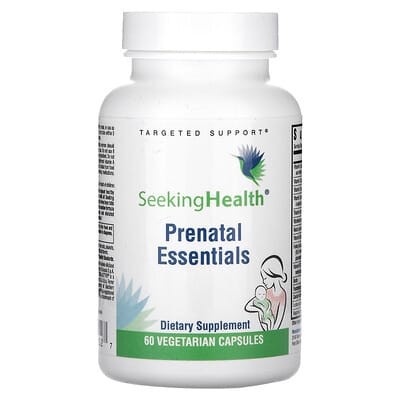

$38.00 $1.26 per serving


Product analysis
Prenatal Essentials Chewable offers a broad nutrient mix in a chewable format, with several favorable mineral forms. The serving price compares poorly for many individual nutrients.
AI assessment of the formula, label and price. How scoring works
Nutrient Quality61
Several mineral forms are quality strengths, and the B2 and B6 forms are clearly identified. Other ingredients remain harder to judge, while the vitamin A source proportions are missing.
Ingredient Transparency77
All listed amounts and most forms are stated, making much of the label easy to compare. Vitamin A source proportions are missing, so each source’s contribution is unclear.
Value For Money29
The full serving price compares poorly for several vitamins and minerals. Many remaining comparisons are uncertain, limiting confidence in the complete formula’s value.
Customer Satisfaction89
Customer feedback is very positive across a large number of ratings. The volume supports a broad picture of satisfaction without establishing prenatal benefits.
Product Focus33
The large nutrient list and broad range of intended uses make the formula less focused. It has some support for those uses, with no ingredient confirmed unnecessary.
- Format
Capsule - Container
- 60 Capsule(s)
- Per serving
- $1.26
- Customer rating
- 4.9 · 2,239 ratings
Goals

Impact
Highest effect
Folate · 1360 mcg DFEVitamin B12 · 100 mcgVitamin D · 25 mcgMagnesium · 100 mgVitamin K · 100 mcgBoron · 1 mgZinc · 13 mgVitamin C · 100 mg
B vitamins and folate provide nutritional support for energy-related processes and blood formation, while magnesium, D and K contribute to mineral-related nutrition. Iodine can address low intake relevant to thyroid function, and zinc adds antioxidant-category coverage. These roles do not establish extra benefit when nutrition is adequate. B12's unresolved amount limits its saved contribution, while the small C, calcium and boron amounts are excluded; named active forms receive no assumed superiority.
How this product is rated for Everyday Health
Ingredient fit72
Several nutrients contribute with uneven amount coverage; B12's amount remains unresolved and low C, calcium and boron are excluded.
Goal fit
Other actives and links to other goals reduce focus on the counted nutritional contributions.
Dose adequacy
Many B vitamins, folate and iodine reach full amount coverage; several minerals and vitamins receive partial coverage, while B12 has no usable amount.
Pathways100
The strongest coverage is in energy-related processes and blood formation, with sufficient mineral-metabolism coverage as well.
Depth
Energy-related processes and blood formation reach full coverage.
Breadth
Three categories meet the threshold: energy-related processes, blood formation, and mineral metabolism.
Evidence86
Magnesium leads the evidence finding, with conditional usefulness for dietary gaps.
Evidence strength
Magnesium supplies the leading evidence contribution without establishing extra outcomes above adequate nutrition.
Studied preparation
Eligible declarations receive full preparation recognition; activated vitamin and chelate names receive no automatic advantage.
Formulation logic98
Partner checks are satisfied and no configured conflict was found; unresolved B12 limits complete minimum-dose coverage.
Partner coverage
No counted nutrient lacks a required partner.
Conflicts
No configured ingredient conflict was matched.
Effective doses
Most counted nutrients pass the minimum amount threshold; B12's unresolved amount does not.

Impact
Moderate effect
Iodine · 220 mcgVitamin D · 25 mcgVitamin B5 · 20 mgMagnesium · 100 mgRiboflavin · 10 mgThiamin · 5 mgVitamin B12 · 100 mcg
B vitamins and magnesium support normal energy metabolism, while folate contributes to normal blood-related nutrient functions. The large folate amount does not imply a larger energy benefit once nutritional needs are met.
Vitamin D may help fill a dietary gap, while B12 exposure remains unresolved because its amount is undisclosed.
How this product is rated for Energy
Ingredient fit55
Relevant nutrients sit within a broad prenatal formula. The relevant ingredients provide a partial saved exposure match.
Goal fit
Relevant nutrients sit within a broad prenatal formula.
Dose adequacy
The relevant ingredients provide a partial saved exposure match.
Pathways0
The saved findings show no meaningful coverage of the core energy pathways.
Depth
The saved findings show no meaningful coverage of the core energy pathways.
Breadth
No core area reaches the saved meaningful-coverage threshold.
Evidence94
Vitamin D leads the saved evidence finding. Most effective ingredients match the saved preparation references; iodine does not.
Evidence strength
Vitamin D is the strongest effective ingredient in the saved finding.
Studied preparation
Most effective ingredients match the saved preparation references; iodine does not.
Formulation logic98
The assessed ingredients have no missing required partner or listed conflict. 10 of 11 assessed ingredients reach the saved minimum exposure level; Vitamin B12 falls below it.
Partner coverage
The assessed ingredients can contribute alone or have their required partner.
Conflicts
No listed conflict was found in the supplied assessment.
Effective doses
10 of 11 assessed ingredients reach the saved minimum exposure level; Vitamin B12 falls below it.
Vitamin B5 Not classified
No linked studies yet.

Impact
High effect
Vitamin K · 100 mcgMagnesium · 100 mgVitamin B12 · 100 mcgVitamin B6 · 15 mgFolate · 1360 mcg DFEVitamin D · 25 mcg
Magnesium contributes to the balance of minerals and blood-vessel tone, although blood-pressure effects in trials are small and inconsistent. Folate, B6 and B12 participate in homocysteine processing, but lowering this blood marker has not generally reduced major cardiac outcomes. MK-7 vitamin K has limited support for arterial-stiffness measures, particularly from studies in postmenopausal women; this does not establish prevention of heart attacks.
How this product is rated for Heart Health
Ingredient fit52
Relevant nutrients sit within a broader formula, and their amounts provide differing levels of exposure comparison.
Goal fit
The formula includes relevant nutrients alongside ingredients aimed at other goals, reducing its heart-health focus.
Dose adequacy
The counted amounts provide partial exposure comparisons, with lower amounts limiting the expected contribution.
Pathways60
Homocysteine processing is the strongest finding, although changing this marker does not establish fewer cardiac events.
Depth
Homocysteine processing is the strongest finding, although changing this marker does not establish fewer cardiac events.
Breadth
One area reaches the saved comparison threshold, so the findings remain concentrated rather than spanning several heart-health mechanisms.
Evidence89
Magnesium leads the evidence finding, although blood-pressure results are small and inconsistent.
Evidence strength
Magnesium leads the evidence finding, although blood-pressure results are small and inconsistent.
Studied preparation
The counted preparations match the saved study comparison; matching a preparation alone does not establish the same benefit for every user.
Formulation logic100
The counted ingredients have no missing required partner or identified configured conflict. Their amounts meet the saved minimum comparison.
Partner coverage
No required partner is missing for the counted ingredients; this does not establish an extra benefit from combining them.
Conflicts
No configured ingredient conflict was identified in the supplied facts.
Effective doses
The counted ingredients meet the saved minimum amount comparison; this threshold does not prove clinical effectiveness.

Impact
Moderate effect
Folate · 1360 mcg DFEVitamin B12 · 100 mcgVitamin B6 · 15 mgMolybdenum · 50 mcgMagnesium · 100 mgVitamin E · 50 mgZinc · 13 mgVitamin C · 100 mgRiboflavin · 10 mg
Folate, betaine and B vitamins support methyl-group and related nutrient pathways, while magnesium and zinc act as enzyme cofactors. Vitamins C and E support antioxidant defenses; these normal functions provide nutritional support, with uncertain extra clearance benefits when nutrient intake is already adequate.
How this product is rated for Liver & Detox
Ingredient fit48
The formula serves broader purposes, with a smaller share directly relevant to liver support. The amounts give partial support, with small or unresolved quantities limiting the contribution.
Goal fit
The formula serves broader purposes, with a smaller share directly relevant to liver support.
Dose adequacy
The amounts give partial support, with small or unresolved quantities limiting the contribution.
Pathways18
The clearest connection is to detox-enzyme induction, with partial coverage in the saved findings. Support remains below the saved threshold across the reviewed mechanisms.
Depth
The clearest connection is to detox-enzyme induction, with partial coverage in the saved findings.
Breadth
Support remains below the saved threshold across the reviewed mechanisms.
Evidence96
Vitamin B9 (Folate) provides the strongest evidence among ingredients counted at a meaningful amount. The practical benefit remains dependent on context. Preparation matching is limited for Molybdenum, Vitamin B2 (Riboflavin), Vitamin B6; the saved evidence cannot be fully transferred to that declaration.
Evidence strength
Vitamin B9 (Folate) provides the strongest evidence among ingredients counted at a meaningful amount. The practical benefit remains dependent on context.
Studied preparation
Preparation matching is limited for Molybdenum, Vitamin B2 (Riboflavin), Vitamin B6; the saved evidence cannot be fully transferred to that declaration.
Formulation logic97
The relevant ingredients can contribute independently or have their required partner. No ingredient conflicts were identified in the saved assessment.
Partner coverage
The relevant ingredients can contribute independently or have their required partner.
Conflicts
No ingredient conflicts were identified in the saved assessment.
Effective doses
7 of 8 relevant ingredients reach the saved meaningful-amount threshold. Limited or unresolved amounts remain for Vitamin B12.
Riboflavin Not classified
No linked studies yet.
Vitamin B6 Not classified
No linked studies yet.

Impact
Moderate effect
Biotin · 150 mcgVitamin D · 25 mcgZinc · 13 mgVitamin C · 100 mg
Zinc may help reduce diffuse shedding when low zinc is the cause. Getting enough matters, but extra zinc isn't known to regrow hair when your intake is already adequate. The other vitamins and minerals have normal biological roles, but those roles alone don't show that taking more will increase hair growth.
How this product is rated for Hair Health
Ingredient fit55
Zinc provides the main practical connection to hair here. Amounts and ingredient identity don't determine the cause of hair loss.
Goal fit
Several ingredients relate to hair or nutrient adequacy, alongside ingredients intended for other purposes.
Dose adequacy
One selected serving provides Vitamin B7 (Biotin) 150 mcg, Copper 0.75 mg, Vitamin B9 (Folate) 1360 mcg DFE. Vitamin B12 amounts remain unresolved.
Pathways3
The ingredients relate mainly to the materials involved in hair fibres, with limited hair-specific benefit.
Depth
The ingredients relate mainly to the materials involved in hair fibres, with limited hair-specific benefit.
Breadth
The main connection is limited to particular hair-related processes; it doesn't imply action on every cause of hair loss.
Evidence97
Zinc's clearest hair benefit concerns shedding caused by low zinc, rather than regrowth when zinc intake is adequate. Iodine supports thyroid hormone production, but its form doesn't demonstrate routine treatment of hair loss.
Evidence strength
Zinc's clearest hair benefit concerns shedding caused by low zinc, rather than regrowth when zinc intake is adequate.
Studied preparation
Iodine supports thyroid hormone production, but its form doesn't demonstrate routine treatment of hair loss.
Formulation logic97
No required partner or particular ingredient conflict is identified. Ingredient amounts don't by themselves confirm a hair benefit.
Partner coverage
No required ingredient partner is missing for the ingredients considered here.
Conflicts
No particular ingredient conflict is identified for this goal.
Effective doses
Vitamin B12 has an unresolved or low amount relative to the dose comparison; this doesn't prove ineffectiveness.

Impact
Highest effect
Vitamin K · 100 mcgMagnesium · 100 mgCalcium · 100 mgVitamin D · 25 mcgCopper · 0.75 mgManganese · 2 mgBoron · 1 mgZinc · 13 mgVitamin C · 100 mg
Vitamin D helps calcium absorption and supports mineralization when intake or vitamin D status is low. MK-7 supports bone-protein activation, with limited and mixed bone-density findings in postmenopausal women. Copper supports collagen cross-linking, with added bone benefit mainly tied to correcting inadequate intake. The saved nutrient contributions do not establish routine fracture prevention.
How this product is rated for Bone Health
Ingredient fit59
The formula supplies several bone-related nutrients, with much of its support tied to normal nutrition. The included nutrients provide mixed amount comparisons; several reach their saved references while others provide partial contributions.
Goal fit
The formula supplies several bone-related nutrients, with much of its support tied to normal nutrition.
Dose adequacy
The included nutrients provide mixed amount comparisons; several reach their saved references while others provide partial contributions.
Pathways100
The saved findings concentrate on calcium absorption, bone-protein activation, collagen formation.
Depth
The saved findings concentrate on calcium absorption, bone-protein activation, collagen formation.
Breadth
These areas reach the saved coverage threshold.
Evidence98
Vitamin K supplies the strongest saved evidence. Normal nutrient roles and limited bone-density findings do not establish routine fracture prevention.
Evidence strength
Vitamin K supplies the strongest saved evidence; its retained contribution does not establish fracture prevention.
Studied preparation
The included preparations meet the saved preparation criterion; this does not prove superior absorption or fracture outcomes.
Formulation logic96
Vitamin D retains an individual contribution, but calcium is absent or below the required partner amount. No configured conflict was identified.
Partner coverage
Vitamin D retains an individual contribution, but calcium is absent or below the required partner amount.
Conflicts
No configured conflict was identified in the supplied findings.
Effective doses
Some included ingredients lack enough usable amount information to meet the saved minimum criterion.
Ingredients
| Ingredient | Amount per serving | Score |
|---|---|---|
Vitamin A (Beta-Carotene, Retinyl Palmitate) | 1500 mcg RAE | |
Vitamin C (Ascorbic Acid) | 100 mg | |
Vitamin D3 (Cholecalciferol) | 25 mcg | |
Vitamin E (D-Alpha-Tocopheryl Succinate) | 50 mg | |
Thiamine (Thiamine Hydrochloride) | 5 mg | |
Riboflavin (Riboflavin 5-Phosphate Sodium) | 10 mg | |
Niacin | 25 mg | |
Vitamin B6 (Pyridoxal 5-Phosphate) | 15 mg | |
Folate (Quatrefolic) | 1360 mcg DFE | |
MecobalActive (Vitamin B12) | 100 mcg | |
Biotin | 150 mcg | |
Pantothenic Acid (D-Calcium Pantothenate) | 20 mg | |
Calcium (Dicalcium Malate) | 100 mg | |
Iodine (Potassium Iodide) | 220 mcg | |
Magnesium (Dimagnesium Malate) | 100 mg | |
Zinc (Zinc Bisglycinate Chelate) | 13 mg | |
SelenoExcell (Selenium) | 50 mcg | |
Copper (Copper Bisglycinate Chelate) | 0.75 mg | |
Manganese (Manganese Bisglycinate Chelate) | 2 mg | |
Chromium (Chromium Nicotinate Glycinate Chelate) | 100 mcg | |
Molybdenum (Molybdenum Glycinate Chelate) | 50 mcg | |
Betaine | 150 mg | |
Zeaxanthin (Tagetes erecta) | 1 mg | |
Boron (Bororganic Glycine) | 1 mg | |
Lutein (Marigold Flower Extract) | 1 mg | |
Vitamin K2 (Menaquinone-7) | 100 mcg |
Vitamin B6 (Pyridoxal 5-Phosphate) · 15 mg OverallScore72
A serving provides 15 mg of vitamin B6, above the European adult daily upper limit. The identified form is pyridoxal 5-phosphate.
How this ingredient is rated
Ingredient Form & Label Quality100
The identified vitamin B6 form is pyridoxal 5-phosphate. The saved facts do not flag the artificial colors, titanium dioxide or talc checked by the evaluation.
Vitamin B6 Form Identification
The saved facts identify pyridoxal 5-phosphate as the vitamin B6 source.
Clean Label and Excipient Purity
The saved facts do not flag the artificial colors, titanium dioxide or talc checked by the evaluation.
Dose, Safety & Label Transparency69
15 mg of vitamin B6 per serving exceeds the European adult daily upper limit. The chemical source is identified.
Vitamin B6 Dose & Safety Policy
15 mg of vitamin B6 per serving exceeds the European adult daily upper limit.
Label Transparency
The saved facts identify pyridoxal 5-phosphate as the vitamin B6 source.
Value19
At about $1.27 per whole-product serving, the cost is relatively high in relation to its vitamin B6 amount.
Vitamin B6 Price Efficiency
The whole-product serving costs about $1.27 and provides 15 mg of vitamin B6.
Iodine (Potassium Iodide) · 220 mcg OverallScore84
Each serving supplies 220 mcg of iodine as potassium iodide. A whole-product serving costs about $1.27.
How this ingredient is rated
Active Ingredient Quality & Bioavailability100
The iodine is supplied as potassium iodide, a form favored by the evaluation.
Iodine Form & Bioavailability
Potassium iodide is the disclosed form of iodine, and the evaluation favors this form.
Marine Source Purity & Sourcing
No marine source is identified in the available facts, so the marine-specific purity criterion does not apply.
Dose, Safety & Label Transparency100
Each serving provides 220 mcg of iodine, and the amount is disclosed. The evaluation does not flag it for high iodine content.
Dosage Efficacy for Daily Support
The serving provides 220 mcg of iodine, an amount the evaluation favors for routine iodine intake.
Dosage Safety & Upper Limits
The amount does not trigger the evaluation’s high-iodine warning.
Elemental Iodine Transparency
The iodine amount is stated as 220 mcg per serving.
Value20
A whole-product serving costs about $1.27.
Price Per Effective Serving
A whole-product serving costs about $1.27.
Manganese (Manganese Bisglycinate Chelate) · 2 mg OverallScore78
Each serving lists 2 mg of manganese from manganese bisglycinate. A whole-product serving costs about $1.27.
How this ingredient is rated
Active Ingredient Quality & Bioavailability100
The stated manganese form is manganese bisglycinate.
Manganese Chemical Form
The stated manganese form is manganese bisglycinate.
Dose, Safety & Label Transparency86
The serving lists 2 mg of manganese itself, from manganese bisglycinate.
Manganese Dosage Efficacy & Safety
The serving provides 2 mg of manganese.
Elemental Weight Disclosure
The 2 mg refers to manganese itself rather than the total weight of a compound.
Value20
A whole-product serving costs about $1.27.
Price per Serving vs. Median
The whole-product serving costs about $1.27.
Alternative products
Report alternatives
Sources
Published studies used for the product analysis and the top-ranked studies for each ingredient and goal.
- [Comparative study of the urinary excretion of boron, calcium, magnesium and phosphorus in postmenopausal women with and without osteoporosis].
- Effect of dietary boron on mineral, estrogen, and testosterone metabolism in postmenopausal women.
- The relationship between boron and magnesium status and bone mineral density in the human: a review.
- Effects of boron supplementation on bone mineral density and dietary, blood, and urinary calcium, phosphorus, magnesium, and boron in female athletes.
- Metabolic responses of postmenopausal women to supplemental dietary boron and aluminum during usual and low magnesium intake: boron, calcium, and magnesium absorption and retention and blood mineral concentrations
- What is the impact of daily oral supplementation of vitamin D3 (cholecalciferol) plus calcium on the incidence of hip fracture in older people? A systematic review and meta-analysis.
- Calcium supplementation prevents seasonal bone loss and changes in biochemical markers of bone turnover in elderly New England women: a randomized placebo-controlled trial.
- The effects of calcium supplementation (milk powder or tablets) and exercise on bone density in postmenopausal women.
- The efficacy of calcium supplementation alone in elderly Thai women over a 2-year period: a randomized controlled trial.
- Calcium-enriched foods and bone mass growth in prepubertal girls: a randomized, double-blind, placebo-controlled trial.
- The Association between Dietary and Circulating Copper Levels and Osteoporosis: a Scoping Review.
- Association between dietary copper, iron, zinc, selenium intake and osteopenia or osteoporosis in elderly hypertensive patients: a retrospective cohort study.
- Associations of dietary copper intake with total bone mineral density and lumbar spine bone mineral density in American adults.
- The association between dietary mineral intake and bone mineral density: a cross-sectional study.
- Association between dietary copper intake and bone mineral density in children and adolescents aged 8-19 years: A cross-sectional study.
- Association between RBC folate and lumbar bone mineral density in postmenopausal women, a cross-sectional study from NHANES 2009-2018.
- Genetic variants modify the associations of concentrations of methylmalonic acid, vitamin B-12, vitamin B-6, and folate with bone mineral density.
- Adequate Intake and Supplementation of B Vitamins, in Particular Folic Acid, can Play a Protective Role in Bone Health.
- Relation of homocysteine, folate, and vitamin B12 to bone mineral density of postmenopausal women.
- Dietary intake of folate, but not vitamin B2 or B12, is associated with increased bone mineral density 5 years after the menopause: results from a 10-year follow-up study in early postmenopausal women.