
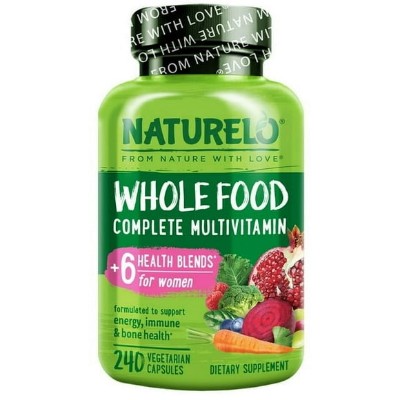
Whole Food Multivitamin for Women

Goals
$67.41 $2.24 per serving


Product analysis
Whole Food Multivitamin for Women brings vitamins and minerals together to help fill dietary gaps and support normal nutrient functions. Its added blends have unclear individual contents, making their contribution harder to judge.
AI assessment of the formula, label and price. How scoring works
Nutrient Quality39
The identified MK-7 and phosphorus forms provide useful details for comparing the ingredients. Some named mineral preparations do not establish their exact underlying forms, and the blends remain incompletely described.
Ingredient Transparency76
All declared amounts and most forms are stated, making the main nutrient contributions easy to compare. Proportions within combined sources and blends are missing, obscuring each component contribution.
Value For Money31
Several mineral and vitamin K comparisons indicate weak value at the serving cost. Value for many remaining nutrients is uncertain, so the extensive ingredient list does not establish a good buy.
Customer Satisfaction77
Customer feedback is very positive across several hundred ratings. That provides a useful satisfaction signal, though the feedback base is smaller than for products with many thousands of ratings.
Product Focus5
The main role is filling ordinary nutrient gaps, with magnesium providing a meaningful contribution to normal mineral functions. Numerous blends and unresolved individual amounts make the wider benefits less clear.
- Format
Capsule - Container
- 120 Capsule(s)
- Per serving
- $2.24
- Customer rating
- 4.7 · 448 ratings
Goals

Impact
Highest effect
Phosphorus · 125 mgVitamin K · 120 mcgMagnesium · 300 mgCalcium · 200 mgVitamin D · 22 mcgCopper · 0.9 mgManganese · 2.3 mgZinc · 11 mgVitamin C · 150 mg

Impact
High effect
Vitamin K · 120 mcgMagnesium · 300 mgVitamin B12 · 6 mcgVitamin B6 · 4 mgFolate · 400 mcg DFEVitamin D · 22 mcg

Impact
Highest effect
Folate · 400 mcg DFEVitamin B12 · 6 mcgVitamin D · 22 mcgMagnesium · 300 mgVitamin K · 120 mcgSelenium · 55 mcgZinc · 11 mgVitamin C · 150 mg

Impact
High effect
Magnesium · 300 mgVitamin C · 150 mgZinc · 11 mgVitamin A · 900 mcg RAEVitamin D · 22 mcgSelenium · 55 mcg

Impact
Moderate effect
Iodine · 150 mcgVitamin D · 22 mcgVitamin B5 · 9 mgMagnesium · 300 mgRiboflavin · 3 mgThiamin · 3 mgVitamin B12 · 6 mcgIron · 14 mgPotassium · 75 mg
Vitamin B5 Not classified
No linked studies yet.

Impact
High effect
Vitamin K · 120 mcgPotassium · 75 mgMagnesium · 300 mgVitamin D · 22 mcgSelenium · 55 mcgVitamin B12 · 6 mcgVitamin B6 · 4 mgVitamin E · 20 mg ATFolate · 400 mcg DFENiacin · 20 mg NEVitamin C · 150 mg
Ingredients
| Ingredient | Amount per serving | Score |
|---|---|---|
Vitamin A (natural Beta Carotene) | 900 mcg RAE | |
Vitamin C (Acerola Cherry Extract, L-Ascorbate) | 150 mg | |
Vitamin D3 (Cholecalciferol) | 22 mcg | |
Vitamin E (D-Alpha-Tocopheryl) | 20 mg AT | |
Vitamin B1 (Thiamine Hydrochloride) | 3 mg | |
Vitamin B2 (Riboflavin) | 3 mg | |
Vitamin B3 (Niacinamide) | 20 mg NE | |
Vitamin B6 (Pyridoxal 5-Phosphate) | 4 mg | |
Folate (L-5-Methylfolate) | 400 mcg DFE | |
Vitamin B12 (Methylcobalamin) | 6 mcg | |
Biotin (D-Biotin) | 150 mcg | |
Vitamin B5 (D-Calcium Pantothenate) | 9 mg | |
Calcium (Aquamin, Dicalcium Phosphate) | 200 mg | |
Iron (Ferrous Bisglycinate) | 14 mg | |
Phosphorus (Dicalcium Phosphate) | 125 mg | |
Iodine (Kelp, Wild) | 150 mcg | |
Magnesium (Aquamin Magnesium) | 300 mg | |
Zinc (Zinc Amino Acid Chelate) | 11 mg | |
Selenium (Selenium Glycinate) | 55 mcg | |
Copper (Copper Aminomin) | 0.9 mg | |
Manganese (Manganese Sulfate) | 2.3 mg | |
Chromium (Chromium Picolinate) | 35 mcg | |
Molybdenum (Molybdenum Krebs Complex) | 45 mcg | |
Potassium (Potassium Chloride) | 75 mg | |
Vitamin K2 (Menaquinone-7) | 120 mcg | |
Organic Fruit & Vegetable Blend | 200 mg | |
Digestive Enzyme & Probiotic Blend | 120 mg | |
Energy Blend | 100 mg | |
Brain Health Blend | 60 mg | |
Heart Health Blend | 50 mg | |
Eye Health Blend | 15 mg |
Vitamin K (Menaquinone-7) · 120 mcg OverallScore73
Phosphorus (Dicalcium Phosphate) · 125 mg OverallScore76
Iodine (Kelp, Wild) · 150 mcg OverallScore58
Alternative products
Report alternatives
Sources
Published studies used for the product analysis and the top-ranked studies for each ingredient and goal.
- What is the impact of daily oral supplementation of vitamin D3 (cholecalciferol) plus calcium on the incidence of hip fracture in older people? A systematic review and meta-analysis.
- Calcium supplementation prevents seasonal bone loss and changes in biochemical markers of bone turnover in elderly New England women: a randomized placebo-controlled trial.
- The effects of calcium supplementation (milk powder or tablets) and exercise on bone density in postmenopausal women.
- The efficacy of calcium supplementation alone in elderly Thai women over a 2-year period: a randomized controlled trial.
- Calcium-enriched foods and bone mass growth in prepubertal girls: a randomized, double-blind, placebo-controlled trial.
- The Association between Dietary and Circulating Copper Levels and Osteoporosis: a Scoping Review.
- Association between dietary copper, iron, zinc, selenium intake and osteopenia or osteoporosis in elderly hypertensive patients: a retrospective cohort study.
- Associations of dietary copper intake with total bone mineral density and lumbar spine bone mineral density in American adults.
- The association between dietary mineral intake and bone mineral density: a cross-sectional study.
- Association between dietary copper intake and bone mineral density in children and adolescents aged 8-19 years: A cross-sectional study.
- Association between RBC folate and lumbar bone mineral density in postmenopausal women, a cross-sectional study from NHANES 2009-2018.
- Genetic variants modify the associations of concentrations of methylmalonic acid, vitamin B-12, vitamin B-6, and folate with bone mineral density.
- Adequate Intake and Supplementation of B Vitamins, in Particular Folic Acid, can Play a Protective Role in Bone Health.
- Relation of homocysteine, folate, and vitamin B12 to bone mineral density of postmenopausal women.
- Dietary intake of folate, but not vitamin B2 or B12, is associated with increased bone mineral density 5 years after the menopause: results from a 10-year follow-up study in early postmenopausal women.
- Association between Serum Magnesium and Fractures: A Systematic Review and Meta-Analysis of Observational Studies.
- Bioabsorbable Magnesium-Based Materials Potential and Safety in Bone Surgery: A Systematic Review.
- Vascularized bone grafting fixed by biodegradable magnesium screw for treating osteonecrosis of the femoral head.
- An update on magnesium and bone health.
- Sex-specific differences in the association of magnesium intake with femoral neck bone mineral density among older adults.