
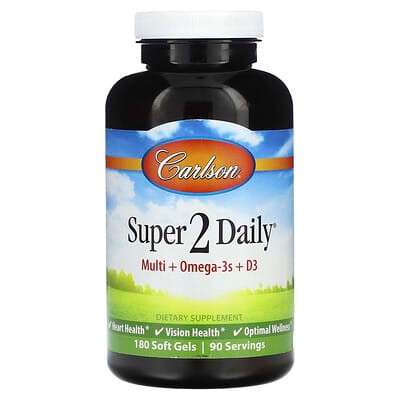

$54.00 $0.60 per serving


Product analysis
Super 2 Daily combines vitamins, minerals and fish oil that can help fill dietary gaps and support normal metabolism. Its broad ingredient list and missing component details make it harder to choose for one specific need.
AI assessment of the formula, label and price. How scoring works
Nutrient Quality53
Several mineral forms compare favorably, and niacin and B6 are clearly identified. Other forms are omitted or remain uncertain, so quality varies across the combination.
Ingredient Transparency70
Every ingredient amount and most forms are listed. Several forms and some component details remain undisclosed.
Value For Money40
Molybdenum and chromium compare favorably, while vitamin C, niacin, vitamin B5, boron and fish oil offer poor value. Price comparisons for several other ingredients remain uncertain.
Customer Satisfaction76
Customer ratings are very positive. The relatively small review count gives a less settled picture than for extensively reviewed products.
Product Focus30
The long ingredient list spans many health goals. Its clearest contribution is nutritional support when intake is low, with less basis for broad added benefits.
- Format
Softgel - Container
- 180 Softgel(s)
- Per serving
- $0.60
- Customer rating
- 4.8 · 235 ratings
Goals

Impact
Highest effect
Magnesium · 100 mgVitamin C · 600 mgZinc · 15 mgVitamin A · 3000 mcg RAEVitamin D · 40 mcgSelenium · 210 mcg
Vitamin C supports normal immune function and has limited evidence for modestly shortening colds with regular use, without establishing infection prevention. Zinc, Selenium, Vitamin D and Vitamin A contribute to normal immune function when intake is low, including vitamin A's role in protective barriers. Folate, Vitamin B6, Vitamin B12 and Copper provide further nutritional support when low intake impairs immune-cell function. Magnesium's nutritional and biomarker roles do not establish a routine immune outcome.
How this product is rated for Immunity
Ingredient fit63
Vitamin C is a principal relevant ingredient. Declared amounts provide partial contributions, with smaller or unresolved quantities limiting the amount comparison.
Goal fit
Relevant ingredients share the formula with other actives, making its focus on this goal less concentrated.
Dose adequacy
Most relevant amounts make substantial contributions, with some below their supplied comparison endpoints.
Pathways100
The strongest represented area is barrier and antimicrobial defense, with substantial coverage. 4 areas reach substantial coverage, representing several aspects of the goal.
Depth
The strongest represented area is barrier and antimicrobial defense, with substantial coverage.
Breadth
4 areas reach substantial coverage, representing several aspects of the goal.
Evidence100
Vitamin C anchors the saved findings. Nutritional or regular-use findings support bounded expectations rather than a promise to prevent infection.
Evidence strength
Vitamin C provides the strongest contribution in the saved findings; this does not establish infection prevention or benefits above adequate nutritional intake.
Studied preparation
The relevant ingredients meet the supplied preparation criteria, without establishing superiority of individual forms.
Formulation logic100
The relevant ingredients have no unmet partner requirement or triggered conflict. Their amounts meet the supplied minimum comparison level.
Partner coverage
The relevant ingredients can contribute independently or have their required partner present; no added combination benefit is established.
Conflicts
None of the evaluated ingredient conflicts was triggered.
Effective doses
The relevant amounts meet the supplied minimum comparison level; this is not a guaranteed clinical response threshold.

Impact
Highest effect
Folate · 680 mcg DFEVitamin B12 · 120 mcgVitamin D · 40 mcgMagnesium · 100 mgFish Oil · 800 mgBoron · 2 mgSelenium · 210 mcgZinc · 15 mgVitamin C · 600 mg
Folate and the B vitamins provide nutrients relevant to normal metabolism and blood formation. Vitamin D adds a nutritional contribution relevant to bone and mineral health. Zinc and Selenium and Vitamin C add further nutritional contributions. These contributions matter when dietary intake is inadequate; additional benefits above adequate intake are not established.
How this product is rated for Everyday Health
Ingredient fit76
The included nutritional ingredients share the formula with ingredients serving other purposes, reducing its general-health focus. Declared amounts provide partial coverage of the saved comparisons; this concerns nutrient availability rather than a proven clinical response.
Goal fit
The included nutritional ingredients share the formula with ingredients serving other purposes, reducing its general-health focus.
Dose adequacy
Declared amounts provide partial coverage of the saved comparisons; this concerns nutrient availability rather than a proven clinical response.
Pathways100
The strongest connection is energy metabolism cofactors. This describes the main supplied functional connection. The findings span several functional areas, indicating broader coverage without establishing added benefit from combining ingredients.
Depth
The strongest connection is energy metabolism cofactors. This describes the main supplied functional connection.
Breadth
The findings span several functional areas, indicating broader coverage without establishing added benefit from combining ingredients.
Evidence86
The saved findings recognize evidence and preparation matches for the included ingredients. Nutritional availability and narrower outcomes do not establish routine broad health improvement.
Evidence strength
Magnesium leads the saved evidence comparison; its nutritional or indication-specific evidence does not establish broad benefits above adequate status.
Studied preparation
Included preparations matched the saved comparison, without establishing superiority of delivery or chemical form.
Formulation logic100
Included ingredients had no missing required partners or configured conflicts and reached the saved minimum amount threshold.
Partner coverage
No required partner was missing among the included ingredients; this does not establish synergy.
Conflicts
No configured ingredient conflict was identified in the supplied facts.
Effective doses
All included ingredients reached the saved minimum amount threshold; excluded low amounts are not necessarily nutritionally worthless.

Impact
Highest effect
Folate · 680 mcg DFEVitamin B12 · 120 mcgVitamin B6 · 20 mgMolybdenum · 75 mcgSelenium · 210 mcgMagnesium · 100 mgVitamin E · 268 mgZinc · 15 mgVitamin C · 600 mgRiboflavin · 17 mg
Folate participates in methyl-group metabolism, with arsenic-related findings limited to defined exposure and folate-status settings; they do not establish routine detoxification or equivalence of methylfolate. Selenium has small studies involving low selenium status or mercury exposure, rather than general toxin clearance. The other enzyme and antioxidant nutrient roles do not demonstrate increased toxin removal.
How this product is rated for Liver & Detox
Ingredient fit59
Vitamin B9 (Folate) is relevant to the saved ingredient finding. Declared quantities support the amount comparison, without establishing clinical toxin clearance.
Goal fit
Relevant ingredients sit within a broader formula; other actives and links to other goals limit detoxification-specific focus.
Dose adequacy
Relevant declared amounts provide partial overall coverage; this amount comparison does not establish a clinical detoxification dose.
Pathways100
The strongest saved finding concerns liver integrity and fat export. Three categories reach the coverage threshold.
Depth
Liver integrity and fat export reaches the saved coverage target. This finding does not measure toxin elimination.
Breadth
Liver cell integrity and fat export, Methyl-group supply, Detox-enzyme induction are the categories meeting the coverage threshold; gut binding does not contribute.
Evidence98
Vitamin B9 (Folate) leads the saved evidence finding. Its scientific context limits routine detoxification claims despite the recorded ingredient allowance.
Evidence strength
Folate leads this finding; arsenic studies depend on exposure, folate status and preparation, rather than demonstrating routine detoxification.
Studied preparation
Some ingredients lack studied preparation correspondence, including Molybdenum, Vitamin B2 (Riboflavin), Vitamin B6. Matching the others does not establish routine toxin clearance.
Formulation logic100
There is no unmet required partner or matched conflict. Included ingredients meet the amount threshold, which does not establish a combined toxin-removal effect.
Partner coverage
No required partner is missing in the saved findings. This does not establish added benefit from combining ingredients.
Conflicts
No configured conflict was matched. This limited finding does not establish general safety.
Effective doses
All ingredients included in this rule meet its saved amount threshold; previously excluded ingredients remain excluded. This is not a proven toxin-clearance threshold.
Riboflavin Not classified
No linked studies yet.
Vitamin B6 Not classified
No linked studies yet.

Impact
High effect
Biotin · 300 mcgNiacin · 40 mgVitamin B12 · 120 mcgRiboflavin · 17 mgThiamin · 15 mgVitamin B5 · 40 mgVitamin B6 · 20 mgVitamin D · 40 mcgZinc · 15 mgMagnesium · 100 mg
Iodine supports thyroid hormone production and can help restore normal heat production when iodine deficiency impairs thyroid function. Extra iodine does not establish a boost when intake and thyroid function are adequate. B vitamins support normal energy metabolism, while chromium's glucose-related findings do not establish increased calorie expenditure.
How this product is rated for Metabolism Support
Ingredient fit68
Vitamin B1 (Thiamin) contributes to the saved ingredient and amount findings. The supplied scientific context limits expectations for a direct metabolism boost.
Goal fit
The formula includes ingredients serving other purposes, reducing its specific focus on the included metabolism-related ingredients.
Dose adequacy
Some included amounts provide partial comparison contributions, without establishing how much energy expenditure would change.
Pathways12
The included routes emphasize insulin sensitivity and metabolic hormones. None reaches the coverage threshold.
Depth
The strongest included route concerns insulin sensitivity and metabolic hormones; this does not establish a direct rise in calorie expenditure.
Breadth
No route meets the coverage threshold, leaving limited breadth across energy-expenditure mechanisms.
Evidence100
Vitamin B1 (Thiamin) leads the included evidence finding. Cellular energy roles and metabolic biomarkers do not by themselves demonstrate higher whole-body energy expenditure.
Evidence strength
Vitamin B1 (Thiamin) leads the saved evidence comparison, while its supplied findings do not establish a routine energy-expenditure boost.
Studied preparation
The included preparations are accepted for comparison; this does not establish that the product reproduces a thermogenesis trial.
Formulation logic100
No missing partner or configured conflict is identified. Meeting comparison amounts does not establish added thermogenesis from the formula.
Partner coverage
The supplied findings identify no missing partner needed by the included ingredients.
Conflicts
No configured ingredient conflict is identified in the supplied formula; this is a limited interaction check.
Effective doses
The included ingredients meet the minimum amount threshold, which does not establish an effective thermogenic dose.

Impact
Moderate effect
Iodine · 300 mcgVitamin D · 40 mcgVitamin B5 · 40 mgMagnesium · 100 mgRiboflavin · 17 mgThiamin · 15 mgVitamin B12 · 120 mcgFish Oil · 800 mg
B vitamins support normal energy metabolism and help maintain nutritional adequacy. Folate and vitamin B12 are particularly relevant when low nutrient status contributes to tiredness. Benefits are most plausible when a dietary gap is present; high vitamin amounts do not guarantee extra energy. Fish oil adds a small contribution in the saved findings, although fish-oil mass alone does not identify EPA and DHA exposure.
How this product is rated for Energy
Ingredient fit63
The saved findings identify 11 relevant contributors within a broader ingredient mix. Declared amounts provide partial support against the saved references. Undisclosed amounts cannot add amount support.
Goal fit
The saved findings identify 11 relevant contributors within a broader ingredient mix.
Dose adequacy
Declared amounts provide partial support against the saved references. Undisclosed amounts cannot add amount support.
Pathways2
The strongest saved connection is mitochondrial energy production, with limited coverage. No energy pathway reaches the saved threshold for substantial coverage.
Depth
The strongest saved connection is mitochondrial energy production, with limited coverage.
Breadth
No energy pathway reaches the saved threshold for substantial coverage.
Evidence94
Vitamin D provides the strongest evidence contribution in the saved findings. The fatigue evidence is particularly dependent on vitamin D status. Most qualifying contributors have recognized preparations in the saved findings; preparation support is missing for Iodine, Vanadium.
Evidence strength
Vitamin D provides the strongest evidence contribution in the saved findings. The fatigue evidence is particularly dependent on vitamin D status.
Studied preparation
Most qualifying contributors have recognized preparations in the saved findings; preparation support is missing for Iodine, Vanadium.
Formulation logic100
No unmet ingredient-partner requirement appears in the saved findings. No configured ingredient conflict was matched in the saved findings. All credited contributors meet the saved minimum amount threshold, which does not guarantee a noticeable energy benefit.
Partner coverage
No unmet ingredient-partner requirement appears in the saved findings.
Conflicts
No configured ingredient conflict was matched in the saved findings.
Effective doses
All credited contributors meet the saved minimum amount threshold, which does not guarantee a noticeable energy benefit.
Vitamin B5 Not classified
No linked studies yet.

Impact
Highest effect
Zinc · 15 mgVitamin C · 600 mgCopper · 2 mgSelenium · 210 mcgVitamin E · 268 mg
Vitamin C supports collagen formation and wound healing, with the clearest benefit when intake is low. The zinc, B6, riboflavin can help address deficiency-related skin problems, without established extra cosmetic benefit at adequate intake. Copper supports collagen cross-linking, but this does not establish firmer skin from supplementation. The carotenoid amount or preparation does not establish the exposure used in the small skin trials.
How this product is rated for Skin Health
Ingredient fit68
Relevant skin nutrients sit within a broader formula containing ingredients directed at other goals. Most relevant declared amounts fit the saved comparison, with some smaller contributions; serving frequency is not assumed.
Goal fit
Relevant skin nutrients sit within a broader formula containing ingredients directed at other goals.
Dose adequacy
Most relevant declared amounts fit the saved comparison, with some smaller contributions; serving frequency is not assumed.
Pathways80
The strongest recorded connection is to skin structure; nutrient roles in collagen do not establish visible firmness or wrinkle improvement.
Depth
The strongest recorded connection is to skin structure; nutrient roles in collagen do not establish visible firmness or wrinkle improvement.
Breadth
Skin structure and antioxidant responses reached the saved breadth criterion; direct water-binding support was not established.
Evidence100
Vitamin C provides the strongest recorded evidence contribution here; its supported role must retain the ingredient-specific limitations on routine cosmetic benefit.
Evidence strength
Vitamin C provides the strongest recorded evidence contribution here; its supported role must retain the ingredient-specific limitations on routine cosmetic benefit.
Studied preparation
The counted preparations met the saved preparation comparison; this does not establish cosmetic benefit beyond the outcomes and populations described.
Formulation logic100
No required partner was missing among the counted ingredients; this does not demonstrate an added benefit from combining them. No configured ingredient conflict was recorded in the supplied comparison.
Partner coverage
No required partner was missing among the counted ingredients; this does not demonstrate an added benefit from combining them.
Conflicts
No configured ingredient conflict was recorded in the supplied comparison.
Effective doses
The counted ingredients met the saved minimum amount criterion; that threshold is not a proven effective skin dose.
Ingredients
| Ingredient | Amount per serving | Score |
|---|---|---|
Calories | 20 Calorie(s) | |
Total Fat | 1.5 Gram(s) | |
Cholesterol | 5 mg | |
Total Carbohydrate | 1 Gram(s) | |
Protein | 1 Gram(s) | |
Vitamin A (Beta-Carotene) | 3000 mcg RAE | |
Vitamin C (Calcium Ascorbate) | 600 mg | |
Vitamin D (Cholecalciferol) | 40 mcg | |
Vitamin E (D-Alpha-Tocopherol) | 268 mg | |
Thiamine (Thiamine Mononitrate) | 15 mg | |
Riboflavin | 17 mg | |
Niacin (Niacinamide) | 40 mg | |
Vitamin B6 (Pyridoxine Hydrochloride) | 20 mg | |
Folate | 680 mcg DFE | |
Vitamin B12 (Cyanocobalamin) | 120 mcg | |
Biotin | 300 mcg | |
Pantothenic Acid (Calcium D-Pantothenate) | 40 mg | |
Calcium (Calcium Ascorbate, Calcium D-Pantothenate, Dicalcium Phosphate) | 70 mg | |
Iodine (Potassium Iodide) | 300 mcg | |
Magnesium (Magnesium Oxide) | 100 mg | |
Zinc (Zinc Glycinate) | 15 mg | |
Selenium (Selenomethionine) | 210 mcg | |
Copper (Copper Glycinate) | 2 mg | |
Manganese (Manganese Glycinate) | 3 mg | |
Chromium (Chromium Nicotinate) | 240 mcg | |
Molybdenum (Molybdenum Glycinate) | 75 mcg | |
Lutein | 800 mcg | |
Boron (Boron Glycinate) | 2 mg | |
Vanadium (Bis(Maltolato)OxoVanadium) | 400 mcg | |
Norwegian Fish Oil | 800 mg |
Iodine (Potassium Iodide) · 300 mcg OverallScore90
Each serving provides 300 mcg of iodine as potassium iodide. The whole-product serving costs about $0.60.
How this ingredient is rated
Active Ingredient Quality & Bioavailability100
Potassium iodide is the identified iodine form; no marine origin is indicated in the saved facts.
Iodine Form & Bioavailability
Potassium iodide is the identified iodine form.
Marine Source Purity & Sourcing
No marine source is indicated in the saved facts, so the marine-specific sourcing criterion does not apply; that does not establish contaminant absence.
Dose, Safety & Label Transparency100
The saved iodine amount is 300 mcg per serving; it does not exceed the limit used in the evaluation.
Dosage Efficacy for Daily Support
A serving supplies 300 mcg of iodine.
Dosage Safety & Upper Limits
The recorded iodine amount does not exceed the limit used in the evaluation.
Elemental Iodine Transparency
The iodine amount is specified as 300 mcg per serving.
Value50
The whole-product serving costs about $0.60.
Price Per Effective Serving
The whole-product serving costs about $0.60.
Copper (Copper Glycinate) · 2 mg OverallScore84
Each serving provides 2 mg of copper as copper glycinate, the amount favored by the evaluation. 15 mg zinc per serving accompanies the copper; their proportions fall outside the balance favored by the evaluation.
How this ingredient is rated
Active Ingredient Quality & Bioavailability100
Copper Glycinate is an amino acid chelate favored for absorption in the evaluation. The copper row gives both its source and amount.
Copper Form Bioavailability
Copper Glycinate is an amino acid chelate favored for absorption in the evaluation.
Elemental Copper Labeling Clarity
The copper row identifies 2 mg per serving and names copper glycinate as its source.
Dose, Safety & Label Transparency85
Each serving supplies 2 mg of copper, the amount favored by the evaluation. 15 mg zinc per serving accompanies the copper; their proportions fall outside the balance favored by the evaluation.
Copper Dosage Safety & Efficacy
Each serving supplies 2 mg of copper, the amount favored by the evaluation.
Zinc-to-Copper Balance
15 mg zinc per serving accompanies the copper; their proportions fall outside the balance favored by the evaluation.
Value50
The whole-product price is about $0.60 per serving.
Price Per Serving Efficiency
A whole-product serving costs about $0.60; that price covers the product, not copper alone.
Niacin (Niacinamide) · 40 mg OverallScore54
Niacin comes as niacinamide, which does not have the same effects on blood lipids as nicotinic acid despite the stated heart-health goal. The saved amount is 40 mg per serving.
How this ingredient is rated
Active Ingredient Quality & Bioavailability57
Niacinamide is a standard form, but it does not have nicotinic acid’s specific effects on blood lipids for the stated heart-health goal.
Niacin Form & Goal Alignment
Niacinamide does not have the specific blood-lipid effects of nicotinic acid for the stated heart-health goal.
Precursor Source Quality
Niacinamide is a standard niacin form; no advanced NAD+ claim is recorded.
Dose, Safety & Label Transparency67
The saved information identifies niacinamide and records 40 mg per serving; the evaluation of that amount is cautious.
Clarity of Chemical Form
The saved information identifies the niacin form as niacinamide.
Form-Specific Dosage Efficacy
The saved evaluation makes a cautious assessment of the 40 mg per serving for this form.
Flush Risk & Safety Labeling
No no-flush claim is recorded in the saved information.
Value20
A whole-product serving costs about $0.60; that price covers the complete serving.
Price Per Effective Serving
A whole-product serving costs about $0.60; that price covers the complete serving.
Alternative products
Report alternatives
Sources
Published studies used for the product analysis and the top-ranked studies for each ingredient and goal.
- [Comparative study of the urinary excretion of boron, calcium, magnesium and phosphorus in postmenopausal women with and without osteoporosis].
- Effect of dietary boron on mineral, estrogen, and testosterone metabolism in postmenopausal women.
- The relationship between boron and magnesium status and bone mineral density in the human: a review.
- Effects of boron supplementation on bone mineral density and dietary, blood, and urinary calcium, phosphorus, magnesium, and boron in female athletes.
- Metabolic responses of postmenopausal women to supplemental dietary boron and aluminum during usual and low magnesium intake: boron, calcium, and magnesium absorption and retention and blood mineral concentrations
- What is the impact of daily oral supplementation of vitamin D3 (cholecalciferol) plus calcium on the incidence of hip fracture in older people? A systematic review and meta-analysis.
- Calcium supplementation prevents seasonal bone loss and changes in biochemical markers of bone turnover in elderly New England women: a randomized placebo-controlled trial.
- The effects of calcium supplementation (milk powder or tablets) and exercise on bone density in postmenopausal women.
- The efficacy of calcium supplementation alone in elderly Thai women over a 2-year period: a randomized controlled trial.
- Calcium-enriched foods and bone mass growth in prepubertal girls: a randomized, double-blind, placebo-controlled trial.
- The Association between Dietary and Circulating Copper Levels and Osteoporosis: a Scoping Review.
- Association between dietary copper, iron, zinc, selenium intake and osteopenia or osteoporosis in elderly hypertensive patients: a retrospective cohort study.
- Associations of dietary copper intake with total bone mineral density and lumbar spine bone mineral density in American adults.
- The association between dietary mineral intake and bone mineral density: a cross-sectional study.
- Association between dietary copper intake and bone mineral density in children and adolescents aged 8-19 years: A cross-sectional study.
- Association between RBC folate and lumbar bone mineral density in postmenopausal women, a cross-sectional study from NHANES 2009-2018.
- Genetic variants modify the associations of concentrations of methylmalonic acid, vitamin B-12, vitamin B-6, and folate with bone mineral density.
- Adequate Intake and Supplementation of B Vitamins, in Particular Folic Acid, can Play a Protective Role in Bone Health.
- Relation of homocysteine, folate, and vitamin B12 to bone mineral density of postmenopausal women.
- Dietary intake of folate, but not vitamin B2 or B12, is associated with increased bone mineral density 5 years after the menopause: results from a 10-year follow-up study in early postmenopausal women.