
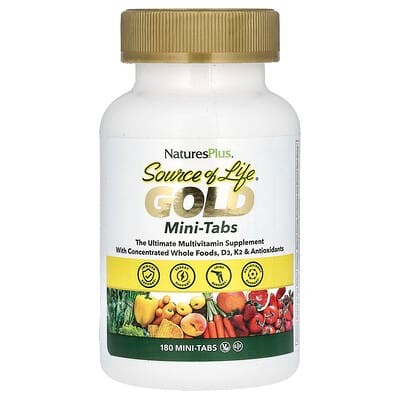

$55.99 $1.86 per serving


Product analysis
Source of Life Gold Mini-Tabs offers broad vitamin and mineral support for filling dietary gaps. Its high serving cost and incompletely identified blends make it harder to justify if you mainly want basic nutritional support.
AI assessment of the formula, label and price. How scoring works
Nutrient Quality42
The formula includes clearly identified vitamin K and B6 forms, but ingredient quality varies widely. Undisclosed source shares and unidentified blends make several mineral and botanical portions harder to judge.
Ingredient Transparency71
All listed amounts and most ingredient forms are disclosed. Many source shares and blend contents are missing, leaving the complete mixture difficult to understand precisely.
Value For Money29
The high serving cost weakens value across many of the nutrients and added actives. Vitamin K, CoQ10 and rutin compare especially poorly, while biotin offers more moderate value.
Customer Satisfaction82
Customer feedback is favorable across more than a thousand ratings. The sizeable review base describes satisfaction without proving broad health benefits.
Product Focus0
The clearest purpose is filling nutritional gaps, but the extensive mixture spreads across many health goals. Unidentified blends and uncertain botanical contributions make the additional benefits difficult to judge.
- Format
Tablet - Container
- 180 Tablet(s)
- Per serving
- $1.86
- Also available
 Source of Life Gold Tablets$54.78
- Customer rating
- 4.6 · 1,838 ratings
Goals

Impact
Highest effect
Magnesium · 125 mgVitamin C · 1010 mgZinc · 15 mgVitamin A · 4505 mcg RAEVitamin D · 25 mcgSelenium · 70 mcg
Zinc, Vitamin D, Selenium contribute to normal immune-cell function and regulation. Vitamin A also supports protective barriers. Copper, Vitamin B6, Vitamin B12, Folate can help restore immune processes impaired by low intake, without establishing extra protection when intake is adequate. Vitamin C has modest regular-use cold-duration support, without establishing infection prevention. Higher Vitamin B6 and Vitamin A amounts do not establish extra benefit or suitability.
How this product is rated for Immunity
Ingredient fit56
Vitamin C connects the formula to immunity. Amounts provide uneven support against the supplied comparisons; smaller or unresolved quantities limit some contributions.
Goal fit
Relevant immune nutrients are included within a broader formula with other active ingredients.
Dose adequacy
Amounts provide uneven support against the supplied comparisons; smaller or unresolved quantities limit some contributions.
Pathways100
The strongest saved finding concerns barrier and antimicrobial defense.
Depth
The strongest saved finding concerns barrier and antimicrobial defense.
Breadth
The broader saved findings cover barrier and antimicrobial defense, innate immune cell activity, lymphocyte function and immune regulation, oxidative and inflammatory balance.
Evidence100
Vitamin C provides the strongest saved evidence finding. Nutritional function or modest regular-use symptom support does not establish general infection prevention.
Evidence strength
Vitamin C drives the strongest saved evidence finding; the practical support remains bounded by its specific nutritional or regular-use role.
Studied preparation
The saved finding accepts the declared forms without establishing that they outperform other forms.
Formulation logic100
No unmet ingredient partner or configured conflict was identified. The included contributors meet the saved minimum amount criterion; this does not establish clinical effectiveness.
Partner coverage
The included ingredients have no unmet partner requirement in the supplied findings.
Conflicts
No configured ingredient conflict was identified in the supplied findings.
Effective doses
The included contributors meet the saved minimum amount criterion; this does not establish clinical effectiveness.

Impact
Highest effect
Folate · 708 mcg DFEVitamin B12 · 1000 mcgVitamin D · 25 mcgMagnesium · 125 mgVitamin K · 100 mcgBoron · 1 mgSelenium · 70 mcgZinc · 15 mgVitamin C · 1010 mg
B vitamins supply nutrients used in energy metabolism, with folate and B12 contributing to blood formation. Vitamins D and K contribute to mineral nutrition, while vitamin C, zinc and selenium support normal antioxidant and immune functions when intake is low. Calcium, magnesium and iodine add nutritional contributions. The supplied context does not establish broad health benefits from CoQ10, despite its inclusion in the saved result.
How this product is rated for Everyday Health
Ingredient fit66
The contributing ingredients supply partial amounts overall; this comparison does not establish a clinical benefit threshold.
Goal fit
Relevant nutrients contribute, while ingredients aimed elsewhere make the product less focused on routine general health.
Dose adequacy
The contributing ingredients supply partial amounts overall; this comparison does not establish a clinical benefit threshold.
Pathways100
The strongest contribution is in energy metabolism, with substantial support in the supplied comparison. Contributions extend across several areas, providing broad nutritional coverage for this goal.
Depth
The strongest contribution is in energy metabolism, with substantial support in the supplied comparison.
Breadth
Contributions extend across several areas, providing broad nutritional coverage for this goal.
Evidence85
Magnesium leads the supplied evidence comparison; normal nutritional functions do not establish additional benefit when intake is adequate.
Evidence strength
Magnesium leads the supplied evidence comparison; normal nutritional functions do not establish additional benefit when intake is adequate.
Studied preparation
Most contributing preparations match those accepted in the comparison; CoQ10 lacks that match, and routine broad benefit remains unestablished.
Formulation logic100
All retained contributors reach the comparison’s minimum amount allowance; this is not a proven clinical treatment threshold.
Partner coverage
The contributing ingredients can act independently or have their required partners; an extra combination benefit is not established.
Conflicts
No configured ingredient conflict was identified in the supplied facts.
Effective doses
All retained contributors reach the comparison’s minimum amount allowance; this is not a proven clinical treatment threshold.
Coenzyme Q10 Not classified
No linked studies yet.

Impact
High effect
Vitamin K · 100 mcgMagnesium · 125 mgCalcium · 250 mgVitamin D · 25 mcgCopper · 4.5 mgManganese · 4 mgBoron · 1 mgZinc · 15 mgVitamin C · 1010 mg
Calcium supplies mineral for normal bone structure and can help fill a dietary intake gap; its 250 mg per serving is a contribution to total intake, not a daily target. Magnesium contributes to normal bone mineral metabolism and can fill low dietary intake, without established routine fracture prevention. Vitamin D supports calcium absorption and deficiency-related mineralization; larger amounts do not establish extra fracture protection in adults with adequate status. MK-7 supports bone-protein activation, with mixed bone-density findings in postmenopausal women and no established general fracture prevention.
How this product is rated for Bone Health
Ingredient fit57
Relevant ingredients sit within a broader formula, so only part of the product is specifically connected to bone health. The included amounts largely meet the saved references, with some providing only partial exposure compared with those references.
Goal fit
Relevant ingredients sit within a broader formula, so only part of the product is specifically connected to bone health.
Dose adequacy
The included amounts largely meet the saved references, with some providing only partial exposure compared with those references.
Pathways80
The main recorded connection is collagen matrix formation. Coverage is concentrated in a limited set of bone-related processes, leaving other aspects without substantial support.
Depth
The strongest recorded connection concerns collagen matrix formation, with substantial coverage from the included ingredients.
Breadth
Coverage is concentrated in a limited set of bone-related processes, leaving other aspects without substantial support.
Evidence97
Calcium provides the strongest recorded evidence. Some preparations do not match the studied material: Vitamin K, Potassium. Shared rubric rule.
Evidence strength
Calcium provides the strongest recorded ingredient evidence at a qualifying amount; its population and outcome limitations still apply.
Studied preparation
Some preparations do not match the studied material: Vitamin K, Potassium. Shared rubric rule.
Formulation logic100
The ingredients work independently or have the required partner in the supplied findings. No listed formulation conflict was matched in the supplied findings. This is limited to the specified checks.
Partner coverage
The ingredients work independently or have the required partner in the supplied findings.
Conflicts
No listed formulation conflict was matched in the supplied findings. This is limited to the specified checks.
Effective doses
All ingredients included in this finding meet its minimum amount threshold; the threshold is not proof of clinical effectiveness.

Impact
Moderate effect
Iodine · 150 mcgVitamin D · 25 mcgVitamin B5 · 125 mgMagnesium · 125 mgRiboflavin · 30 mgThiamin · 30 mgVitamin B12 · 1000 mcgPotassium · 60 mgCoenzyme Q-10 · 50 mg
B vitamins, magnesium, folate and vitamin C support normal energy metabolism and nutritional adequacy relevant to fatigue. Extra energy is not implied when needs are already met, and vitamin D’s fatigue findings concern people with low levels.
CoQ10 at 50 mg adds a limited connection to cellular energy production, with no identified redox form. Several amino-acid and algae declarations remain unresolved, so their presence or amounts cannot be assumed.
How this product is rated for Energy
Ingredient fit57
Thirteen relevant ingredients appear within a broad mixture. Most known nutrient amounts provide substantial support, with a smaller CoQ10 contribution.
Goal fit
Thirteen relevant ingredients appear within a broad mixture.
Dose adequacy
Most known nutrient amounts provide substantial support, with a smaller CoQ10 contribution.
Pathways4
Cellular energy production is the main identified mechanism, with limited overall support.
Depth
Cellular energy production is the main identified mechanism, with limited overall support.
Breadth
No mechanism reaches the saved threshold for broad support across several areas.
Evidence93
Vitamin D provides the strongest saved evidence at a meaningful amount. Most preparations are accepted; CoQ10 and iodine lack matches to tested preparations.
Evidence strength
Vitamin D provides the strongest saved evidence among the ingredients at meaningful amounts.
Studied preparation
Most preparations are accepted; CoQ10 and iodine lack matches to tested preparations.
Formulation logic100
All thirteen assessed ingredients meet the saved minimum amount. No ingredient conflicts were identified.
Partner coverage
The assessed ingredients can contribute independently or have their required partner.
Conflicts
No ingredient conflicts were identified in the saved checks.
Effective doses
All thirteen assessed ingredients meet the saved minimum amount.
Vitamin B5 Not classified
No linked studies yet.

Impact
High effect
Vitamin K · 100 mcgPotassium · 60 mgMagnesium · 125 mgVitamin D · 25 mcgCoenzyme Q-10 · 50 mgSelenium · 70 mcgVitamin B12 · 1000 mcgVitamin B6 · 30 mgVitamin E · 167 mgLycopene · 2.5 mgFolate · 708 mcg DFENiacin · 125 mg NEVitamin C · 1010 mg
CoQ10 offers limited support for blood-vessel-lining and blood-pressure markers, while potassium and magnesium may help vascular tone, particularly with low intake or low magnesium status. Folate, B6 and B12 help process homocysteine without establishing event prevention. Selenium and thiamin contribute mainly when correcting inadequate intake. Several botanicals remain unresolved, and the small quercetin amount is far below studied blood-pressure exposures; mixed vitamin K forms do not establish an eligible MK-7 amount.
How this product is rated for Cardiovascular Support
Ingredient fit53
The broad formula has several relevant nutrients, but unresolved botanicals and mixed vitamin K forms limit attribution.
Goal fit
The broad formula has several relevant nutrients, but unresolved botanicals and mixed vitamin K forms limit attribution.
Dose adequacy
CoQ10, potassium and magnesium receive partial amount comparisons; several B vitamins meet saved references.
Pathways80
The saved findings emphasize homocysteine processing and oxidative protection, with partial vessel-lining and vascular-tone contributions.
Depth
The saved findings emphasize homocysteine processing and oxidative protection, with partial vessel-lining and vascular-tone contributions.
Breadth
Two areas reach the saved coverage threshold.
Evidence88
CoQ10 supplies the strongest saved evidence, based on limited marker studies.
Evidence strength
CoQ10 supplies the strongest saved evidence, based on limited marker studies.
Studied preparation
The saved findings recognize the included preparations as studied; this does not establish identical effects across populations or serving schedules.
Formulation logic98
The included ingredients need no missing partner, and no configured conflict was identified.
Partner coverage
The included ingredients can contribute without a missing required partner.
Conflicts
No configured conflict was identified in the supplied findings; this is not a general safety assessment.
Effective doses
Most included ingredients reach the saved amount criterion; some botanical amounts remain too small or unresolved.

Impact
High effect
Vitamin K · 100 mcgMagnesium · 125 mgCoenzyme Q-10 · 50 mgVitamin B12 · 1000 mcgVitamin B6 · 30 mgFolate · 708 mcg DFEVitamin D · 25 mcg
Folate, B6 and B12 support homocysteine metabolism, although lowering this marker has not generally reduced major cardiac events. CoQ10 has limited support for selected vascular measures, while magnesium and potassium relate to vessel tone with amount-dependent limitations. Thiamin and selenium address deficiency-related heart disease rather than extra prevention when intake is adequate.
How this product is rated for Heart Health
Ingredient fit51
The relevant ingredients provide the included contribution, with partial coverage of the comparison amounts.
Goal fit
The relevant ingredients contribute alongside ingredients directed at other uses.
Dose adequacy
The included amounts partly cover the saved comparison ranges, which describe exposure rather than proven treatment doses.
Pathways60
The strongest recorded connection is homocysteine clearance, with full coverage of the comparison range.
Depth
The strongest recorded connection is homocysteine clearance, with full coverage of the comparison range.
Breadth
Homocysteine clearance reached the coverage threshold; the remaining configured pathways did not.
Evidence98
Coenzyme Q-10 provides the strongest included evidence, within the limits of its studied outcomes and populations.
Evidence strength
Coenzyme Q-10 provides the strongest included evidence, within the limits of its studied outcomes and populations.
Studied preparation
The included preparations were matched to studied material, within the limits of the outcomes and populations studied.
Formulation logic100
No configured ingredient conflict was identified. The included ingredients can stand alone or have their required partner present.
Partner coverage
The included ingredients can stand alone or have their required partner present.
Conflicts
No configured ingredient conflict was identified.
Effective doses
All included ingredients clear the saved minimum amount threshold; this does not guarantee a noticeable clinical benefit.
Ingredients
| Ingredient | Amount per serving | Score |
|---|---|---|
Calories | 5 Calorie(s) | |
Protein | 1 Gram(s) | |
Vitamin A (Beta Carotene) | 4505 mcg RAE | |
Vitamin C (Ascorbic Acid, Esterified C) | 1010 mg | |
Vitamin D3 (Cholecalciferol) | 25 mcg | |
Vitamin E (D-Alpha-Tocopheryl Succinate) | 167 mg | |
Vitamin K2 (Menaquinone-4, Menaquinone-7) | 100 mcg | |
Thiamin (Thiamin HCl) | 30 mg | |
Riboflavin | 30 mg | |
Niacin (Niacinamide) | 125 mg NE | |
Vitamin B6 (Pyridoxine Hydrochloride) | 30 mg | |
Folate (Calcium L-5 Methyltetrahydrofolate) | 708 mcg DFE | |
Vitamin B12 (Methylcobalamin) | 1000 mcg | |
Biotin | 300 mcg | |
Pantothenic Acid (Calcium Pantothenate, Organic Gold Standard) | 125 mg | |
Choline (Choline Bitartrate) | 30 mg | |
Calcium (Di-Calcium Phosphate, Spirulina platensis, Whole Foods, Calcium Citrate) | 250 mg | |
Iodine (Kelp, Potassium Iodide) | 150 mcg | |
Magnesium (Magnesium Aminoate Complex) | 125 mg | |
Zinc (Zinc Aminoate Complex, Zinc Picolinate) | 15 mg | |
Selenium (Selenium Aminoate Complex) | 70 mcg | |
Copper (Chlorophyllin, Copper Aminoate Complex) | 4.5 mg | |
Manganese (Manganese Aminoate Complex) | 4 mg | |
Chromium (Chromium Aminoate Complex) | 120 mcg | |
Potassium (Potassium Aminoate Complex, Spirulina) | 60 mg | |
Whole Food PhytoAlgae & Organic Mushroom Blend | 810 mg | |
Multi Color Whole Food Blend | 725 mg | |
Energizing and Cleansing Green Whole Food Blend | 300 mg | |
Strength and Endurance White Whole Food Blend | 120 mg | |
Defense and Repair Yellow Whole Food Blend | 115 mg | |
Brain Support Blue Whole Food Blend | 55 mg | |
Anti-Aging Red Whole Food Blend | 65 mg | |
Amino Acids (Chia, Mineral Aminoates, Spirulina, Whole Food PhytoAlgae) | 510 mg | |
Whole Food Omega Fatty Acid & Prebiotic Fiber Blend | 200 mg | |
Enzyme Blend | 100 mg | |
Anti-Aging Blend | 50 mg | |
Trans-Resveratrol (Grape Seed Extract, Polygonum cuspidatum Root Extract, Red Wine Extract, Concentrate) | 50 mg | |
Coenzyme Q10 | 50 mg | |
Inositol | 50 mg | |
Bioflavonoid Complex (Citrus spp., Flavanols, Flavanones, Flavones, Phenolic compounds) | 30 mg | |
Whole Food Fiber Complex | 30 mg | |
Korean Ginseng | 25 mg | |
PABA | 25 mg | |
Quercetin (Dimorphandra mollis) | 10 mg | |
Trace Mineral Complex | 10 mg | |
Chlorophyll (Spirulina) | 7.5 mg | |
Rutin (Sophora japonica) | 5 mg | |
Hesperidin Complex (Citrus sinensis) | 5 mg | |
Carotenoids | 4 mg | |
Lutein (Marigold) | 3 mg | |
Lycopene | 2.5 mg | |
Full Spectrum Probiotic Blend | 2 mg | |
Boron (Boron Citrate) | 1 mg | |
Octacosanol | 200 mcg |
Manganese (Manganese Aminoate Complex) · 4 mg OverallScore72
PABA · 25 mg OverallScore78
A serving lists 25 mg of PABA, with the amount stated individually. Scaled from the whole-product serving price, the cost is about $7.47 per 100 mg of PABA.
How this ingredient is rated
Active Ingredient Quality & Bioavailability80
The saved facts identify PABA but do not record a pharmaceutical-grade or purity claim.
PABA Source & Grade
PABA is named, while no specific grade or purity designation is recorded in the saved facts.
Dose, Safety & Label Transparency95
The serving lists 25 mg of PABA. None of the three assessed additive categories are recorded.
PABA Dosage Alignment
The recorded PABA amount is 25 mg per serving.
Label Disclosure Clarity
The PABA amount is individually recorded as 25 mg per serving.
Additive and Excipient Quality
The evaluated facts record no FD&C dyes, titanium dioxide or hydrogenated oils.
Value40
The serving price corresponds to about $7.47 per 100 mg of PABA when scaled from the whole-product price.
Price per 100mg PABA
Based on the whole-product serving price, the equivalent cost is about $7.47 per 100 mg of PABA.
Vitamin B12 (Methylcobalamin) · 1000 mcg OverallScore84
Each serving lists 1,000 mcg of vitamin B12 as methylcobalamin. Using the whole-product price, the cost works out to about $1.87 per 1,000 mcg of B12, including any other ingredients.
How this ingredient is rated
Active Ingredient Quality & Bioavailability100
The named B12 form is methylcobalamin, a coenzyme form.
Bioactive B12 Form Selection
The named B12 form is methylcobalamin, a coenzyme form.
Dose, Safety & Label Transparency100
The label identifies 1,000 mcg of B12 per serving as methylcobalamin.
Therapeutic Dosage Level
The serving provides 1,000 mcg of B12.
Label and Form Transparency
The label identifies 1,000 mcg of B12 per serving as methylcobalamin.
Value20
Using the whole-product price, the cost works out to about $1.87 per 1,000 mcg of B12, including any other ingredients.
Price per 1,000 mcg B12
Using the whole-product price, the cost works out to about $1.87 per 1,000 mcg of B12, including any other ingredients.
Alternative products
Report alternatives
Sources
Published studies used for the product analysis and the top-ranked studies for each ingredient and goal.
- [Comparative study of the urinary excretion of boron, calcium, magnesium and phosphorus in postmenopausal women with and without osteoporosis].
- Effect of dietary boron on mineral, estrogen, and testosterone metabolism in postmenopausal women.
- The relationship between boron and magnesium status and bone mineral density in the human: a review.
- Effects of boron supplementation on bone mineral density and dietary, blood, and urinary calcium, phosphorus, magnesium, and boron in female athletes.
- Metabolic responses of postmenopausal women to supplemental dietary boron and aluminum during usual and low magnesium intake: boron, calcium, and magnesium absorption and retention and blood mineral concentrations
- What is the impact of daily oral supplementation of vitamin D3 (cholecalciferol) plus calcium on the incidence of hip fracture in older people? A systematic review and meta-analysis.
- Calcium supplementation prevents seasonal bone loss and changes in biochemical markers of bone turnover in elderly New England women: a randomized placebo-controlled trial.
- The effects of calcium supplementation (milk powder or tablets) and exercise on bone density in postmenopausal women.
- The efficacy of calcium supplementation alone in elderly Thai women over a 2-year period: a randomized controlled trial.
- Calcium-enriched foods and bone mass growth in prepubertal girls: a randomized, double-blind, placebo-controlled trial.
- The Association between Dietary and Circulating Copper Levels and Osteoporosis: a Scoping Review.
- Association between dietary copper, iron, zinc, selenium intake and osteopenia or osteoporosis in elderly hypertensive patients: a retrospective cohort study.
- Associations of dietary copper intake with total bone mineral density and lumbar spine bone mineral density in American adults.
- The association between dietary mineral intake and bone mineral density: a cross-sectional study.
- Association between dietary copper intake and bone mineral density in children and adolescents aged 8-19 years: A cross-sectional study.
- Association between RBC folate and lumbar bone mineral density in postmenopausal women, a cross-sectional study from NHANES 2009-2018.
- Genetic variants modify the associations of concentrations of methylmalonic acid, vitamin B-12, vitamin B-6, and folate with bone mineral density.
- Adequate Intake and Supplementation of B Vitamins, in Particular Folic Acid, can Play a Protective Role in Bone Health.
- Relation of homocysteine, folate, and vitamin B12 to bone mineral density of postmenopausal women.
- Dietary intake of folate, but not vitamin B2 or B12, is associated with increased bone mineral density 5 years after the menopause: results from a 10-year follow-up study in early postmenopausal women.