
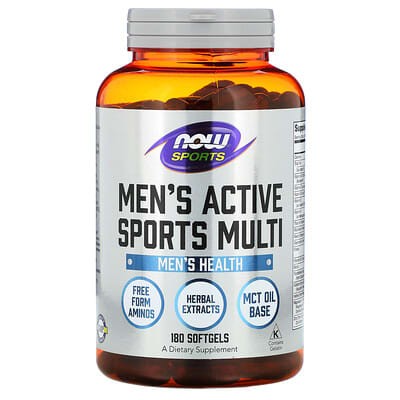

$24.50 $0.40 per serving


Product analysis
Men's Active Sports Multi may help fill dietary gaps affecting normal energy, immunity and bone nutrition. Its broad mixture and unclear blend proportions make targeted benefits harder to judge.
AI assessment of the formula, label and price. How scoring works
Nutrient Quality56
Ingredient quality is mixed, with favorable D3, natural vitamin E and several mineral forms alongside less favorable folate and vitamin K forms. Many added botanicals lack the form detail needed for a reliable comparison.
Ingredient Transparency71
Total amounts and most nutrient forms are disclosed. Several blend proportions and individual botanical details remain unclear, limiting a complete picture of the serving.
Value For Money52
Value varies widely across the ingredients. Vitamin E and B6 compare favorably, while vitamin D, niacin, folate and B5 offer less favorable value.
Customer Satisfaction88
Customers give it very favorable ratings. A large review base supports that satisfaction pattern.
Product Focus0
The clearest role is filling nutritional gaps, with high B vitamin amounts offering no established extra sports benefit. The broad formula and unclear blend contents limit expectations for more targeted effects.
- Format
Softgel - Container
- 180 Softgel(s)
- Per serving
- $0.40
- Also available
 Men's Active Sports Multi$18.25
- Customer rating
- 4.7 · 4,379 ratings
Goals

Impact
Highest effect
Folate · 400 mcgVitamin B12 · 1000 mcgVitamin D · 1000 IUMagnesium · 25 mgVitamin K · 45 mcgSelenium · 200 mcgZinc · 15 mgVitamin C · 120 mg
B vitamins supply nutrients for energy metabolism, with folate and B12 contributing to blood formation when intake is low. Vitamin D and K relate to bone and mineral functions, while vitamin C, zinc and selenium contribute to antioxidant and immune functions. Iodine can help fill a dietary gap relevant to thyroid function. High B-vitamin amounts do not establish extra energy or sports benefits, and taurine's undisclosed amount limits its saved amount finding.
How this product is rated for Everyday Health
Ingredient fit68
The relevant ingredients are closely aligned with the nutritional or functional contribution described. The nutrient amounts contribute unevenly, with smaller contributions from some ingredients.
Goal fit
The relevant ingredients are closely aligned with the nutritional or functional contribution described.
Dose adequacy
The nutrient amounts contribute unevenly, with smaller contributions from some ingredients.
Pathways100
Energy metabolism, blood formation, bone and mineral functions, and antioxidant and immune defence account for the relevant functional coverage. Several nutritional areas meet the saved coverage comparison.
Depth
Energy metabolism, blood formation, bone and mineral functions, and antioxidant and immune defence provide the strongest saved functional finding.
Breadth
Several nutritional areas meet the saved coverage comparison.
Evidence82
Folate provides the strongest saved evidence finding, with nutritional usefulness depending on low intake.
Evidence strength
Folate provides the strongest saved evidence finding, with nutritional usefulness depending on low intake.
Studied preparation
The saved preparation finding is positive for the ingredients meeting its amount comparison; no special form advantage is established.
Formulation logic98
No matched ingredient conflict was identified in the saved findings. An unresolved botanical amount limits the amount finding.
Partner coverage
The credited ingredients can contribute independently or have the partners recognized by the saved findings.
Conflicts
No matched ingredient conflict was identified in the saved findings.
Effective doses
Taurine's unresolved amount falls below the saved amount criterion; the other credited ingredients meet it.

Impact
High effect
Magnesium · 25 mgVitamin C · 120 mgZinc · 15 mgVitamin A · 5000 IUVitamin D · 1000 IUSelenium · 200 mcg
Zinc, B6, B12, folate and copper contribute to normal immune-cell function when intake is low, while selenium contributes to oxidative balance. Adequate nutrient intake does not establish further immune enhancement or infection prevention from supplementation. Vitamins A and E have unresolved usable amounts, and the high B6 declaration does not demonstrate greater benefit or suitability.
How this product is rated for Immunity
Ingredient fit45
Zinc, B vitamins, folate, copper and selenium provide the relevant immune contribution. Vitamins A and E have unresolved usable amounts.
Goal fit
The meaningful immune connection comes from zinc, b vitamins, folate, copper and selenium; other product uses do not establish additional immune outcomes.
Dose adequacy
Vitamins A and E have unresolved usable amounts. The other declared nutrients provide the amount-based contribution.
Pathways76
The strongest contribution concerns lymphocyte regulation and oxidative balance. Two immune areas have substantial representation.
Depth
Lymphocyte regulation and oxidative balance is the strongest represented area.
Breadth
Two immune areas have substantial representation.
Evidence100
Zinc leads the evidence finding. The relevant evidence supports normal nutrient function and low-intake correction, without establishing routine infection prevention.
Evidence strength
The relevant evidence supports normal nutrient function and low-intake correction, without establishing routine infection prevention.
Studied preparation
The included preparations meet the supplied comparison; named forms and delivery methods do not establish superior clinical outcomes.
Formulation logic94
No configured ingredient conflict was identified; that finding is not an overall safety judgment. Vitamins A and E have unresolved usable amounts.
Partner coverage
The included ingredients work independently or have their required partner; this does not demonstrate extra benefit from combining them.
Conflicts
No configured ingredient conflict was identified; that finding is not an overall safety judgment.
Effective doses
Vitamins A and E have unresolved usable amounts. The other included ingredients meet the amount threshold.

Impact
Moderate effect
Iodine · 225 mcgVitamin D · 1000 IUVitamin B5 · 50 mgMagnesium · 25 mgRiboflavin · 50 mgThiamin · 50 mgVitamin B12 · 1000 mcg
B vitamins support normal energy metabolism, while folate and vitamin B12 help maintain normal blood formation. Their energy relevance is mainly nutritional: helping meet needs can matter when intake is low, while high amounts do not promise extra energy once needs are met. Vitamin C adds nutritional support; caffeine-bearing botanical weight is not a declared caffeine dose.
How this product is rated for Energy
Ingredient fit62
Energy-related ingredients share the formula with ingredients aimed at other health goals. The assessed amounts provide substantial but uneven coverage of the saved references.
Goal fit
Energy-related ingredients share the formula with ingredients aimed at other health goals.
Dose adequacy
The assessed amounts provide substantial but uneven coverage of the saved references.
Pathways0
The main contribution is nutritional support rather than a specific assessed performance mechanism. The saved findings show limited coverage across specific energy-performance processes.
Depth
The main contribution is nutritional support rather than a specific assessed performance mechanism.
Breadth
The saved findings show limited coverage across specific energy-performance processes.
Evidence94
Vitamin D provides the strongest evidence contribution among the assessed ingredients, within the supplied evidence's limits. Preparation matching is incomplete for Iodine, limiting direct application of the reviewed findings.
Evidence strength
Vitamin D provides the strongest evidence contribution among the assessed ingredients, within the supplied evidence's limits.
Studied preparation
Preparation matching is incomplete for Iodine, limiting direct application of the reviewed findings.
Formulation logic100
The assessed ingredients can contribute individually or have their required companion present. No configured ingredient conflict was identified in the supplied assessment. All ingredients counted in this finding meet the saved minimum amount threshold.
Partner coverage
The assessed ingredients can contribute individually or have their required companion present.
Conflicts
No configured ingredient conflict was identified in the supplied assessment.
Effective doses
All ingredients counted in this finding meet the saved minimum amount threshold.
Tribulus Not classified
No linked studies yet.
Vitamin B5 Not classified
No linked studies yet.

Impact
High effect
Zinc · 15 mgVitamin C · 120 mgCopper · 2 mgSelenium · 200 mcgLycopene · 500 mcgGreen Tea · 50 mgVitamin E · 100 IU
Zinc, riboflavin, vitamin B6 and vitamin C contribute to normal skin maintenance, especially when intake is low. Copper supports collagen cross-linking, but these normal functions do not establish added cosmetic benefit with adequate nutrition. The gelatin claim remains unresolved in the ingredient inventory, so neither a collagen amount nor a studied peptide preparation can be established. The small lutein and lycopene amounts do not support the studied cosmetic effects.
How this product is rated for Skin Health
Ingredient fit48
The formula includes skin-related nutrients alongside broader nutritional ingredients. Amount contributions vary, and nutrient adequacy does not establish cosmetic effectiveness.
Goal fit
Skin-related nutrients sit within a broader formula, so its focus extends beyond skin.
Dose adequacy
Several nutrient amounts contribute, but unresolved vitamin A and E amounts reduce the amount finding.
Pathways76
The saved findings emphasize collagen-related functions, chiefly through nutrients such as copper; normal function does not establish extra cosmetic benefit.
Depth
The saved findings emphasize collagen-related functions, chiefly through nutrients such as copper; normal function does not establish extra cosmetic benefit.
Breadth
Collagen-related and UV-related functions reach the saved coverage threshold; hydration through hyaluronan does not.
Evidence89
Copper leads the saved findings, but its essential collagen role does not establish added benefit in adequately nourished adults.
Evidence strength
Copper leads the saved findings, but its essential collagen role does not establish added benefit in adequately nourished adults.
Studied preparation
The saved findings accept the forms of the contributing ingredients; this does not establish a tested cosmetic outcome for the whole product.
Formulation logic94
No required partner gap or configured conflict was recorded. Some assessed nutrient amounts remain unresolved.
Partner coverage
No missing required partner was recorded for the contributing ingredients; this does not imply extra benefit from combining them.
Conflicts
No configured ingredient conflict was recorded.
Effective doses
Vitamin A and E do not meet the saved amount threshold because their usable amounts remain unresolved.

Impact
Moderate effect
Vitamin K · 45 mcgMagnesium · 25 mgVitamin D · 1000 IUSelenium · 200 mcgVitamin B12 · 1000 mcgVitamin B6 · 50 mgVitamin E · 100 IULycopene · 500 mcgFolate · 400 mcgNiacin · 50 mgVitamin C · 120 mg
This broad multivitamin includes several cardiovascular-related nutrients, especially 50 mg pyridoxine hydrochloride (vitamin B6), alongside methylcobalamin and folate. Its strongest route is homocysteine clearance, while many other actives serve different goals. Taurine is listed without an individual amount, and the facts do not state how often the product is taken.
How this product is rated for Cardiovascular Support
Ingredient fit46
B6, folate, and B12 fit this goal, but many other active ingredients serve different goals. Taurine is listed without an individual amount.
Goal fit
Ten credited ingredients are mixed with many actives unrelated to this goal and links to numerous other goals.
Dose adequacy
Dose support varies across the credited ingredients; an unknown amount such as taurine's receives no dose credit.
Pathways60
Homocysteine clearance is the only target route with substantial coverage; the other target pathways remain uncovered.
Depth
Homocysteine clearance is the best-covered pathway.
Breadth
Only one target pathway reaches the coverage threshold: homocysteine clearance.
Evidence70
Vitamin B6 provides the strongest ingredient-level evidence at an effective amount, though its evidence ceiling is below the goal's highest. Several other ingredients are also at effective amounts in studied preparations.
Evidence strength
Vitamin B6 has the strongest evidence signal at an effective amount, but its ceiling is below the goal's highest.
Studied preparation
Six ingredients at effective amounts are counted in studied preparations.
Formulation logic94
Credited ingredients work alone or have their partners, and no conflict matched. Taurine and vitamin E fall below the effective-dose threshold.
Partner coverage
Every credited ingredient either works alone or has its required partner.
Conflicts
No listed conflict matched this formula.
Effective doses
Six credited ingredients clear the threshold; taurine and vitamin E fall below it.

Impact
High effect
Folate · 400 mcgVitamin B12 · 1000 mcgVitamin B6 · 50 mgMolybdenum · 75 mcgSelenium · 200 mcgMagnesium · 25 mgVitamin E · 100 IUZinc · 15 mgVitamin C · 120 mgRiboflavin · 50 mg
Folate supports methyl-group metabolism, while selenium supports antioxidant enzymes. Folate’s toxin-related findings concern arsenic-exposed populations and particular folic-acid regimens; selenium’s mercury findings also come from small, selected populations. These findings do not establish routine toxin removal in adults with adequate nutrient intake.
How this product is rated for Liver & Detox
Ingredient fit48
The nutrient mixture provides the saved contributions, with uneven amounts and a broad range of other purposes.
Goal fit
The formula serves several purposes, which limits its concentration on the ingredients counted for this goal.
Dose adequacy
The counted amounts provide partial coverage of the saved references; unresolved amounts add no amount contribution.
Pathways80
The strongest saved coverage concerns methyl-group supply. This describes nutritional or mechanistic coverage, not demonstrated toxin elimination.
Depth
The strongest saved coverage is methyl-group supply, without proof that this increases toxin clearance.
Breadth
The saved coverage reaches methyl-group supply and enzyme-related functions, while other routes remain less covered.
Evidence96
Folate leads the saved evidence finding; its arsenic results depend on exposure, folate status and the folic-acid regimen.
Evidence strength
Folate leads this finding; arsenic-related results cannot be generalized to routine detoxification or every folate form.
Studied preparation
The saved preparation check is incomplete for molybdenum, riboflavin and vitamin B6.
Formulation logic94
The saved findings show no matched ingredient conflict and no missing required partner. Amount eligibility remains separate from proven clinical effectiveness.
Partner coverage
The counted ingredients have their required partners or are treated as working alone; this does not establish added benefit from combining them.
Conflicts
No ingredient conflict was matched in the supplied findings; that is not a comprehensive safety assessment.
Effective doses
Taurine and vitamin E do not meet the saved amount threshold because their eligible amounts remain unresolved.
Riboflavin Not classified
No linked studies yet.
Vitamin B6 Not classified
No linked studies yet.
Ingredients
| Ingredient | Amount per serving | Score |
|---|---|---|
Calories | 25 Calorie(s) | |
Total Fat | 2.5 Gram(s) | |
Vitamin A (Beta-Carotene) | 5000 IU | |
Vitamin C (Ascorbic Acid) | 120 mg | |
Vitamin D3 (Cholecalciferol) | 1000 IU | |
Vitamin E (D-Alpha-Tocopheryl Acetate) | 100 IU | |
Vitamin K (Menaquinone, Phytonadione) | 45 mcg | |
Thiamine (Thiamine Hydrochloride) | 50 mg | |
Riboflavin | 50 mg | |
Niacin (Niacinamide) | 50 mg | |
Vitamin B6 (Pyridoxine Hydrochloride) | 50 mg | |
Folate (Folic Acid) | 400 mcg | |
Vitamin B12 (Methylcobalamin) | 1000 mcg | |
Biotin | 300 mcg | |
Pantothenic Acid (Calcium Pantothenate) | 50 mg | |
Calcium (Calcium Carbonate) | 50 mg | |
Iodine (Potassium Iodide) | 225 mcg | |
Magnesium (Aquamin Seaweed Derived Minerals, Magnesium Aspartate, Magnesium Citrate) | 25 mg | |
Zinc (Zinc Aspartate, Zinc Bisglycinate, Zinc Mono-L-Methionine) | 15 mg | |
Selenium (Selenium Glycinate Complex) | 200 mcg | |
Copper (Copper Bisglycinate) | 2 mg | |
Manganese (Manganese Bisglycinate) | 2 mg | |
Chromium (Chromium Picolinate) | 200 mcg | |
Molybdenum (Sodium Molybdate) | 75 mcg | |
MCT Oil | 1500 mg | |
Amino Acids | 175 mg | |
Tribulus terrestris extract | 100 mg | |
ZMA (Magnesium Aspartate, Pyridoxine Hydrochloride, Zinc Aspartate, Zinc Mono-L-Methionine) | 100 mg | |
CardioAid-S Plant Sterol Esters (Beta-Sitosterol, Campesterol, Stigmasterol) | 100 mg | |
Panax ginseng extract | 100 mg | |
Maca | 50 mg | |
Green Tea extract | 50 mg | |
Saw Palmetto extract | 50 mg | |
Alpha Lipoic Acid | 50 mg | |
Aloe vera leaf concentrate | 50 mg | |
Lutein (Marigold extract) | 500 mcg | |
Lycopene (natural Tomato extract) | 500 mcg |
Iodine (Potassium Iodide) · 225 mcg OverallScore96
Copper (Copper Bisglycinate) · 2 mg OverallScore84
Manganese (Manganese Bisglycinate) · 2 mg OverallScore90
Alternative products
Report alternatives
Sources
Published studies used for the product analysis and the top-ranked studies for each ingredient and goal.
- What is the impact of daily oral supplementation of vitamin D3 (cholecalciferol) plus calcium on the incidence of hip fracture in older people? A systematic review and meta-analysis.
- Calcium supplementation prevents seasonal bone loss and changes in biochemical markers of bone turnover in elderly New England women: a randomized placebo-controlled trial.
- The effects of calcium supplementation (milk powder or tablets) and exercise on bone density in postmenopausal women.
- The efficacy of calcium supplementation alone in elderly Thai women over a 2-year period: a randomized controlled trial.
- Calcium-enriched foods and bone mass growth in prepubertal girls: a randomized, double-blind, placebo-controlled trial.
- The Association between Dietary and Circulating Copper Levels and Osteoporosis: a Scoping Review.
- Association between dietary copper, iron, zinc, selenium intake and osteopenia or osteoporosis in elderly hypertensive patients: a retrospective cohort study.
- Associations of dietary copper intake with total bone mineral density and lumbar spine bone mineral density in American adults.
- The association between dietary mineral intake and bone mineral density: a cross-sectional study.
- Association between dietary copper intake and bone mineral density in children and adolescents aged 8-19 years: A cross-sectional study.
- Association between RBC folate and lumbar bone mineral density in postmenopausal women, a cross-sectional study from NHANES 2009-2018.
- Genetic variants modify the associations of concentrations of methylmalonic acid, vitamin B-12, vitamin B-6, and folate with bone mineral density.
- Adequate Intake and Supplementation of B Vitamins, in Particular Folic Acid, can Play a Protective Role in Bone Health.
- Relation of homocysteine, folate, and vitamin B12 to bone mineral density of postmenopausal women.
- Dietary intake of folate, but not vitamin B2 or B12, is associated with increased bone mineral density 5 years after the menopause: results from a 10-year follow-up study in early postmenopausal women.
- Association between Serum Magnesium and Fractures: A Systematic Review and Meta-Analysis of Observational Studies.
- Bioabsorbable Magnesium-Based Materials Potential and Safety in Bone Surgery: A Systematic Review.
- Vascularized bone grafting fixed by biodegradable magnesium screw for treating osteonecrosis of the femoral head.
- An update on magnesium and bone health.
- Sex-specific differences in the association of magnesium intake with femoral neck bone mineral density among older adults.