
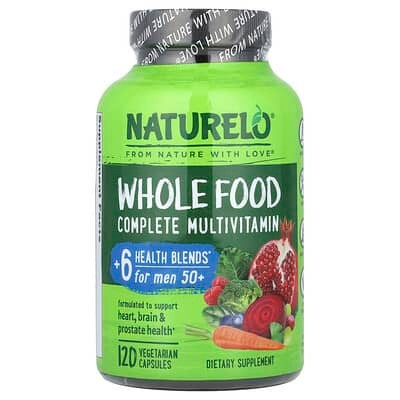
Whole Food Multivitamin for Men 50+

Goals
$46.95 $1.56 per serving


Product analysis
Whole Food Multivitamin for Men 50+ may help fill dietary gaps relevant to normal energy use, immune function and bone nutrition. Incomplete blend breakdowns make the added ingredients harder to compare, while several nutrients offer limited value.
AI assessment of the formula, label and price. How scoring works
Nutrient Quality39
MK-7 is a favorable vitamin K form, while several other mineral forms remain uncertain. The algae and brand descriptions do not establish superior calcium or magnesium absorption.
Ingredient Transparency76
Amounts and most ingredient forms are disclosed, which helps identify the main nutrients. Missing blend breakdowns and combination proportions prevent a full comparison of the added mixtures.
Value For Money30
Several nutrients offer limited value, including vitamin K, phosphorus and selenium. The unclear magnesium form prevents a meaningful value comparison for that mineral.
Customer Satisfaction76
Customer ratings are strongly positive. The smaller review base gives a more limited picture of customer satisfaction.
Product Focus2
The nutrients may help fill gaps relevant to everyday health and normal energy use. Undisclosed blend components and many intended purposes make the full formula less focused.
- Format
Capsule - Container
- 120 Capsule(s)
- Per serving
- $1.56
- Customer rating
- 4.7 · 391 ratings
Goals

Impact
Highest effect
Folate · 400 mcg DFEVitamin B12 · 6 mcgVitamin D · 25 mcgMagnesium · 310 mgVitamin K · 120 mcgSelenium · 55 mcgZinc · 11 mgVitamin C · 190 mg
B vitamins, folate and magnesium provide nutrients used in energy metabolism and blood formation. Vitamin D and K contribute to mineral-related nutrition, while zinc and selenium provide nutrients involved in normal defence functions and iodine helps fill low thyroid-related nutrient intake. These roles chiefly matter when dietary intake is low. Ashwagandha has an undisclosed individual amount, and its preparation-specific stress evidence does not establish routine broad health benefits.
How this product is rated for Everyday Health
Ingredient fit79
The relevant ingredients contribute to energy metabolism, blood formation, mineral metabolism, normal defence functions. Unresolved amounts limit part of the formula. Boron, Coenzyme Q10 and Ginger remain unresolved and add no established contribution.
Goal fit
The counted ingredients align with the nutritional roles described here, although the product is also linked to other goals.
Dose adequacy
Ashwagandha has an unresolved individual amount, limiting the amount that can be supported.
Pathways100
The counted ingredients span energy metabolism, blood formation, mineral metabolism, normal defence functions. These are contributions to normal nutrient functions rather than proof of broad health improvements.
Depth
Folate and the accompanying B vitamins provide the strongest contribution to normal blood formation.
Breadth
The saved findings extend across energy metabolism, blood formation, mineral metabolism, normal defence functions; this describes nutritional roles rather than proven improvements in all these areas.
Evidence86
Magnesium anchors the strongest supported nutritional contribution. The preparation findings do not establish extra benefit from named chemical forms or supplementation above adequate intake.
Evidence strength
Magnesium provides the strongest supported contribution among the counted ingredients, primarily as nutrition for low intake rather than demonstrated extra benefit above adequacy.
Studied preparation
The counted preparations meet the saved preparation finding; no superiority of a named form or delivery method is established.
Formulation logic98
The counted ingredients satisfy the partner and conflict checks, but Ashwagandha has an unresolved amount.
Partner coverage
The counted nutrients work independently or have their required partner present; this does not establish an added combination benefit.
Conflicts
None of the evaluated ingredient combinations triggered a conflict finding; this does not establish overall suitability.
Effective doses
Ashwagandha does not meet the amount check because usable amounts are unresolved; the other counted ingredients meet it.

Impact
Highest effect
Phosphorus · 125 mgVitamin K · 120 mcgMagnesium · 310 mgCalcium · 200 mgVitamin D · 25 mcgCopper · 0.9 mgManganese · 2.3 mgZinc · 11 mgVitamin C · 190 mg
Magnesium supports bone metabolism when intake is low, and vitamin D supports calcium absorption. MK-7 vitamin K has limited, inconsistent postmenopausal bone-density evidence rather than established general fracture prevention. The 200 mg calcium serving did not contribute under the saved criteria, while boron remained unresolved. The saved result recognized several mechanisms, but the Aquamin names do not establish superior bone outcomes.
How this product is rated for Bone Health
Ingredient fit61
Several relevant nutrients appear within a broad formula; boron remains unresolved.
Goal fit
Several relevant nutrients appear within a broad formula; boron remains unresolved.
Dose adequacy
Amounts received partial recognition; calcium and phosphorus did not meet the saved amount criteria.
Pathways100
Collagen matrix formation was the strongest saved finding. Mineral supply, calcium regulation, protein activation and matrix formation reached the saved criteria.
Depth
Collagen matrix formation was the strongest saved finding; this does not measure stronger bone.
Breadth
Mineral supply, calcium regulation, protein activation and matrix formation reached the saved criteria.
Evidence96
Vitamin K drove the saved evidence finding; the amount recognition does not establish extra bone-density or fracture benefit.
Evidence strength
Vitamin K drove the saved evidence finding; the amount recognition does not establish extra bone-density or fracture benefit.
Studied preparation
Potassium lacked studied-preparation recognition.
Formulation logic98
The saved partner check flagged vitamin D's partnership with calcium, reducing recognition; this is a formula finding, not evidence of low dietary calcium. No listed conflict was matched.
Partner coverage
The saved partner check flagged vitamin D's partnership with calcium, reducing recognition; this is a formula finding, not evidence of low dietary calcium.
Conflicts
No listed ingredient conflict was matched in the saved result.
Effective doses
All contributing ingredients met the saved minimum amount criterion; this is not proof of a clinically effective bone dose.

Impact
High effect
Vitamin K · 120 mcgMagnesium · 310 mgVitamin B12 · 6 mcgVitamin B6 · 4 mgFolate · 400 mcg DFEVitamin D · 25 mcg
Magnesium and potassium contribute to electrolyte balance and blood-vessel tone, with inconsistent magnesium effects and potassium’s role dependent on intake and blood pressure. MK-7 has limited arterial-stiffness evidence, while folate participates in homocysteine metabolism without proving general cardiovascular protection. Thiamin and selenium matter in deficiency. CoQ10’s amount is undisclosed, and green tea, resveratrol and grape extract remain unconfirmed.
How this product is rated for Heart Health
Ingredient fit50
The relevant ingredients receive partial amount recognition. The formula’s other actives and links to additional goals also influence its focus.
Goal fit
Relevant ingredients sit within a broader formula; other actives and links to additional goals reduce its focus here.
Dose adequacy
The included serving amounts receive partial recognition; smaller or undisclosed amounts limit the comparison.
Pathways96
The strongest recognized contribution is to electrolyte balance and blood-vessel tone. Blood-vessel tone, arterial-stiffness-related support and homocysteine metabolism all reach the supplied coverage threshold.
Depth
The strongest recognized connection is to electrolyte balance and blood-vessel tone.
Breadth
The saved findings cover blood-vessel tone, arterial-stiffness-related support and homocysteine metabolism.
Evidence89
Magnesium leads the saved evidence finding, though its blood-pressure effects are marginal and inconsistent. The included preparations are recognized as studied.
Evidence strength
Magnesium leads the saved evidence finding, though its blood-pressure effects are marginal and inconsistent.
Studied preparation
The included preparations are recognized as studied in the saved findings, without establishing form superiority.
Formulation logic97
No unmet partner or configured conflict was identified. Coenzyme Q10’s undisclosed amount limits the amount finding.
Partner coverage
The supplied findings identify no unmet required partner for the included ingredients; this does not establish synergy.
Conflicts
No configured ingredient conflict was matched in the supplied findings.
Effective doses
Coenzyme Q10’s undisclosed amount falls below the saved amount check; the other included ingredients meet its threshold.

Impact
Moderate effect
Iodine · 150 mcgVitamin D · 25 mcgVitamin B5 · 9 mgMagnesium · 310 mgRiboflavin · 3 mgThiamin · 3 mgVitamin B12 · 6 mcgPotassium · 75 mg
Magnesium at 310 mg, B vitamins and vitamin C support nutritional sufficiency relevant to fatigue when intake is inadequate. CoQ10 is identified as ubiquinone, but its individual amount is undisclosed; ashwagandha's amount is also unresolved.
How this product is rated for Energy
Ingredient fit59
Focus share 70.3 from 13 credited ingredients and 11 off-goal actives (Calcium, Chromium, Copper, Manganese, Molybdenum, Phosphorus, Selenium, Vitamin A, Vitamin E, Vitamin K, Zinc); link focus 44.5 from 13 linked goals. Goal focus = 70% × share + 30% × link focus The saved amount assessment is partial; unresolved individual amounts limit the assessed contribution.
Goal fit
Focus share 70.3 from 13 credited ingredients and 11 off-goal actives (Calcium, Chromium, Copper, Manganese, Molybdenum, Phosphorus, Selenium, Vitamin A, Vitamin E, Vitamin K, Zinc); link focus 44.5 from 13 linked goals. Goal focus = 70% × share + 30% × link focus
Dose adequacy
The saved amount assessment is partial; unresolved individual amounts limit the assessed contribution.
Pathways0
No assessed energy pathway has meaningful coverage. 0 of 3 target areas meet the saved coverage threshold.
Depth
No assessed energy pathway has meaningful coverage.
Breadth
0 of 3 target areas meet the saved coverage threshold.
Evidence95
Vitamin D is the strongest evidence contributor at an eligible amount in the saved findings. Some eligible preparations match those accepted as studied; Iodine do not.
Evidence strength
Vitamin D is the strongest evidence contributor at an eligible amount in the saved findings.
Studied preparation
Some eligible preparations match those accepted as studied; Iodine do not.
Formulation logic96
The assessed ingredients can contribute alone or have their required partners. No configured ingredient conflicts were identified in the supplied facts. 11 of 13 assessed ingredients meet the saved minimum amount threshold; below it: Coenzyme Q-10, Ashwagandha.
Partner coverage
The assessed ingredients can contribute alone or have their required partners.
Conflicts
No configured ingredient conflicts were identified in the supplied facts.
Effective doses
11 of 13 assessed ingredients meet the saved minimum amount threshold; below it: Coenzyme Q-10, Ashwagandha.
Vitamin B5 Not classified
No linked studies yet.

Impact
High effect
Folate · 400 mcg DFEMagnesium · 310 mgVitamin B12 · 6 mcgVitamin K · 120 mcgVitamin D · 25 mcg
Vitamin C supports collagen formation and vitamin D supports bone and muscle function, with benefit most relevant when low intake or deficiency impairs these functions. B12 is relevant to neurological problems caused by deficiency. These nutritional roles do not establish extra anti-aging benefit when intake is adequate. Magnesium's functional findings were more evident with low dietary intake in exercising older women, without proving general anti-aging effects. CoQ10 and ashwagandha are declared with unresolved amounts; several botanical and carotenoid facts also remain unresolved.
How this product is rated for Longevity
Ingredient fit54
Nutrients contribute within a broad formula; several additional amounts remain unresolved.
Goal fit
Nutrients contribute within a broad formula; several additional amounts remain unresolved.
Dose adequacy
Amounts receive limited recognition overall; CoQ10, ashwagandha and vitamin E lack usable amounts.
Pathways41
Antioxidant defense is the strongest represented area in the saved findings. Other areas have limited coverage.
Depth
Antioxidant defense is the strongest mapped area; the mapping does not establish slower aging or longer life.
Breadth
Only antioxidant defense reaches the saved coverage threshold.
Evidence98
Magnesium leads the saved evidence finding. Vitamin K lacks the recognized studied preparation.
Evidence strength
Magnesium leads the saved evidence finding; its role does not establish universal anti-aging benefit.
Studied preparation
Vitamin K lacks the recognized studied preparation.
Formulation logic93
No unmet partner requirement or configured conflict was found. CoQ10, ashwagandha and vitamin E do not clear the amount threshold because their amounts are unresolved; the other credited ingredients do.
Partner coverage
Each credited ingredient works independently or has its required partner.
Conflicts
No configured conflict was matched among the evaluated combinations.
Effective doses
CoQ10, ashwagandha and vitamin E do not clear the amount threshold because their amounts are unresolved; the other credited ingredients do.

Impact
High effect
Magnesium · 310 mgVitamin C · 190 mgZinc · 11 mgVitamin A · 1100 mcg RAEVitamin D · 25 mcgSelenium · 55 mcg
Vitamin A supports protective barriers, while zinc and vitamin D contribute to normal immune-cell function. Selenium supports normal immune function; extra benefit is not established when intake is already adequate. Copper, folate and vitamins B6 and B12 can help restore immune-cell function when intake is low. These nutritional roles do not establish prevention of respiratory infections.
How this product is rated for Immunity
Ingredient fit56
The formula contains several nutrients related to immune function, with uneven amounts and a broader nutritional focus.
Goal fit
Several nutrients relate to normal immune function, within a formula also serving many other nutritional purposes.
Dose adequacy
The nutrient amounts contribute unevenly, and low or unresolved amounts limit the contribution attributed to the serving.
Pathways76
The strongest finding is lymphocyte function and immune regulation. Two immune functions have meaningful coverage; the remaining functions receive less support.
Depth
The strongest finding concerns lymphocyte function and immune regulation, based on the relevant nutrients and their amounts.
Breadth
Two immune functions have meaningful coverage; the remaining functions receive less support.
Evidence100
The strongest support concerns established nutrient roles in normal immune function. Recognized preparations do not establish additional protection against infections.
Evidence strength
The strongest relevant support concerns normal nutrient function, rather than prevention of infection.
Studied preparation
The saved findings recognize the qualifying nutrient preparations; this does not establish superiority over other forms.
Formulation logic98
The relevant nutrients do not require an additional partner for their recognized roles. No configured conflict was found.
Partner coverage
The relevant nutrients can contribute without a required additional partner; this does not establish synergy.
Conflicts
No configured ingredient conflict was identified in the supplied findings.
Effective doses
Vitamin E has an unresolved amount and does not meet the saved amount criterion; the other qualifying ingredients do.
Ingredients
| Ingredient | Amount per serving | Score |
|---|---|---|
Vitamin A (natural Beta Carotene) | 1100 mcg RAE | |
Vitamin C (Acerola Cherry Extract, L-Ascorbate) | 190 mg | |
Vitamin D3 (Lichen) | 25 mcg | |
Vitamin E (D-Alpha-Tocopherol) | 22 mg a-tocopherol | |
Vitamin K2 (Menaquinone-7) | 120 mcg | |
Vitamin B1 (Thiamine Hydrochloride) | 3 mg | |
Vitamin B2 (Riboflavin) | 3 mg | |
Vitamin B3 (Niacinamide) | 20 mg NE | |
Vitamin B6 (Pyridoxal 5-Phosphate) | 4 mg | |
Folate (L-5-Methylfolate) | 400 mcg DFE | |
Vitamin B12 (Methylcobalamin) | 6 mcg | |
Biotin (D-Biotin) | 150 mcg | |
Vitamin B5 (D-Calcium Pantothenate) | 9 mg | |
Calcium (Aquamin, Dicalcium Phosphate) | 200 mg | |
Phosphorus (Dicalcium Phosphate) | 125 mg | |
Iodine (wild, hand-harvested Kelp) | 150 mcg | |
Magnesium (Aquamin Magnesium) | 310 mg | |
Zinc (Zinc Amino Acid Chelate) | 11 mg | |
Selenium (Selenium Glycinate Complex) | 55 mcg | |
Copper (Copper Aminomin) | 0.9 mg | |
Manganese (Manganese Sulfate) | 2.3 mg | |
Chromium (Chromium Picolinate) | 35 mcg | |
Molybdenum (Molybdenum Krebs Complex) | 45 mcg | |
Potassium (Potassium Chloride) | 75 mg | |
Organic Fruit & Vegetable Blend | 200 mg | |
Digestive Enzyme & Probiotic Blend | 120 mg | |
Prostate Health Blend | 100 mg | |
Brain Health Blend | 60 mg | |
Heart Health Blend | 50 mg | |
Eye Health Blend | 15 mg |
Vitamin K (Menaquinone-7) · 120 mcg OverallScore73
A serving provides 120 mcg of vitamin K. The cost per serving is very high. It uses Menaquinone-7. The MK-7 isomer form isn’t specified.
How this ingredient is rated
Active Ingredient Quality & Bioavailability82
The form is Menaquinone-7. The MK-7 isomer form isn’t specified.
Vitamin K Form (MK-7 vs. MK-4 vs. K1)
The form is Menaquinone-7.
MK-7 Isomer Disclosure
The MK-7 isomer form isn’t specified.
Dose, Safety & Label Transparency100
The label states 120 mcg of vitamin K and names the form.
Vitamin K2 (MK-7) Dosage Efficacy
The serving provides 120 mcg of MK-7.
Form and Subtype Transparency
The label states 120 mcg of vitamin K and names the form.
Value0
The cost per serving is very high.
Price per Effective MK-7 Serving
The cost per serving is very high.
Phosphorus (Dicalcium Phosphate) · 125 mg OverallScore76
Each serving supplies 125 mg of phosphorus from dicalcium phosphate. The whole-product serving costs about $1.57.
How this ingredient is rated
Active Ingredient Quality & Bioavailability79
The phosphorus source is identified as dicalcium phosphate, a mineral phosphate.
Phosphorus Form Quality
dicalcium phosphate is the identified mineral source of phosphorus.
Form Disclosure Clarity
The phosphorus entry identifies dicalcium phosphate as its source.
Dose, Safety & Label Transparency100
The serving states 125 mg of phosphorus.
Dose Adequacy and Safety
The serving supplies 125 mg of phosphorus.
Elemental Dose Transparency
The phosphorus amount is stated as 125 mg per serving.
Value20
A whole-product serving costs about $1.57, a relatively high price.
Price Per Serving Efficiency
A whole-product serving costs about $1.57, a relatively high price.
Copper (Copper Aminomin) · 0.9 mg OverallScore50
A serving provides 0.9 mg of copper from a named source whose chemical form remains unresolved. The same serving contains 11 mg of zinc, a proportion that fits the evaluation’s balance criterion.
How this ingredient is rated
Active Ingredient Quality & Bioavailability30
A copper source name is recorded, but its chemical form is unresolved in the saved facts.
Copper Form Bioavailability
A source is named, but its specific copper chemistry is unresolved, so its form cannot be compared.
Elemental Copper Labeling Clarity
The saved facts record 0.9 mg of elemental copper and a source name on the copper row.
Dose, Safety & Label Transparency86
The serving lists 0.9 mg of elemental copper. The same serving has 11 mg of zinc, a proportion that fits the evaluation’s balance criterion.
Copper Dosage Safety & Efficacy
The serving provides 0.9 mg of copper.
Zinc-to-Copper Balance
The serving has 11 mg zinc and 0.9 mg copper; their proportion fits the evaluation’s balance criterion.
Value20
The whole-product price is relatively high in this comparison.
Price Per Serving Efficiency
The whole product costs about $1.57 per serving.
Alternative products
Report alternatives
Sources
Published studies used for the product analysis and the top-ranked studies for each ingredient and goal.
- What is the impact of daily oral supplementation of vitamin D3 (cholecalciferol) plus calcium on the incidence of hip fracture in older people? A systematic review and meta-analysis.
- Calcium supplementation prevents seasonal bone loss and changes in biochemical markers of bone turnover in elderly New England women: a randomized placebo-controlled trial.
- The effects of calcium supplementation (milk powder or tablets) and exercise on bone density in postmenopausal women.
- The efficacy of calcium supplementation alone in elderly Thai women over a 2-year period: a randomized controlled trial.
- Calcium-enriched foods and bone mass growth in prepubertal girls: a randomized, double-blind, placebo-controlled trial.
- The Association between Dietary and Circulating Copper Levels and Osteoporosis: a Scoping Review.
- Association between dietary copper, iron, zinc, selenium intake and osteopenia or osteoporosis in elderly hypertensive patients: a retrospective cohort study.
- Associations of dietary copper intake with total bone mineral density and lumbar spine bone mineral density in American adults.
- The association between dietary mineral intake and bone mineral density: a cross-sectional study.
- Association between dietary copper intake and bone mineral density in children and adolescents aged 8-19 years: A cross-sectional study.
- Association between RBC folate and lumbar bone mineral density in postmenopausal women, a cross-sectional study from NHANES 2009-2018.
- Genetic variants modify the associations of concentrations of methylmalonic acid, vitamin B-12, vitamin B-6, and folate with bone mineral density.
- Adequate Intake and Supplementation of B Vitamins, in Particular Folic Acid, can Play a Protective Role in Bone Health.
- Relation of homocysteine, folate, and vitamin B12 to bone mineral density of postmenopausal women.
- Dietary intake of folate, but not vitamin B2 or B12, is associated with increased bone mineral density 5 years after the menopause: results from a 10-year follow-up study in early postmenopausal women.
- Association between Serum Magnesium and Fractures: A Systematic Review and Meta-Analysis of Observational Studies.
- Bioabsorbable Magnesium-Based Materials Potential and Safety in Bone Surgery: A Systematic Review.
- Vascularized bone grafting fixed by biodegradable magnesium screw for treating osteonecrosis of the femoral head.
- An update on magnesium and bone health.
- Sex-specific differences in the association of magnesium intake with femoral neck bone mineral density among older adults.